












🌑Knowledge Drop – 67: Appointment to Chief Information Commissioner | For prelims: Highly expected MCQs | For Mains, All G.S Papers: High Quality Essays on iasmonk.com
Appointment to Chief Information Commissioner
Post Date: 20 December 2025
Syllabus:
GS-II | Polity & Governance 🏛️
Statutory Bodies
📍 Context
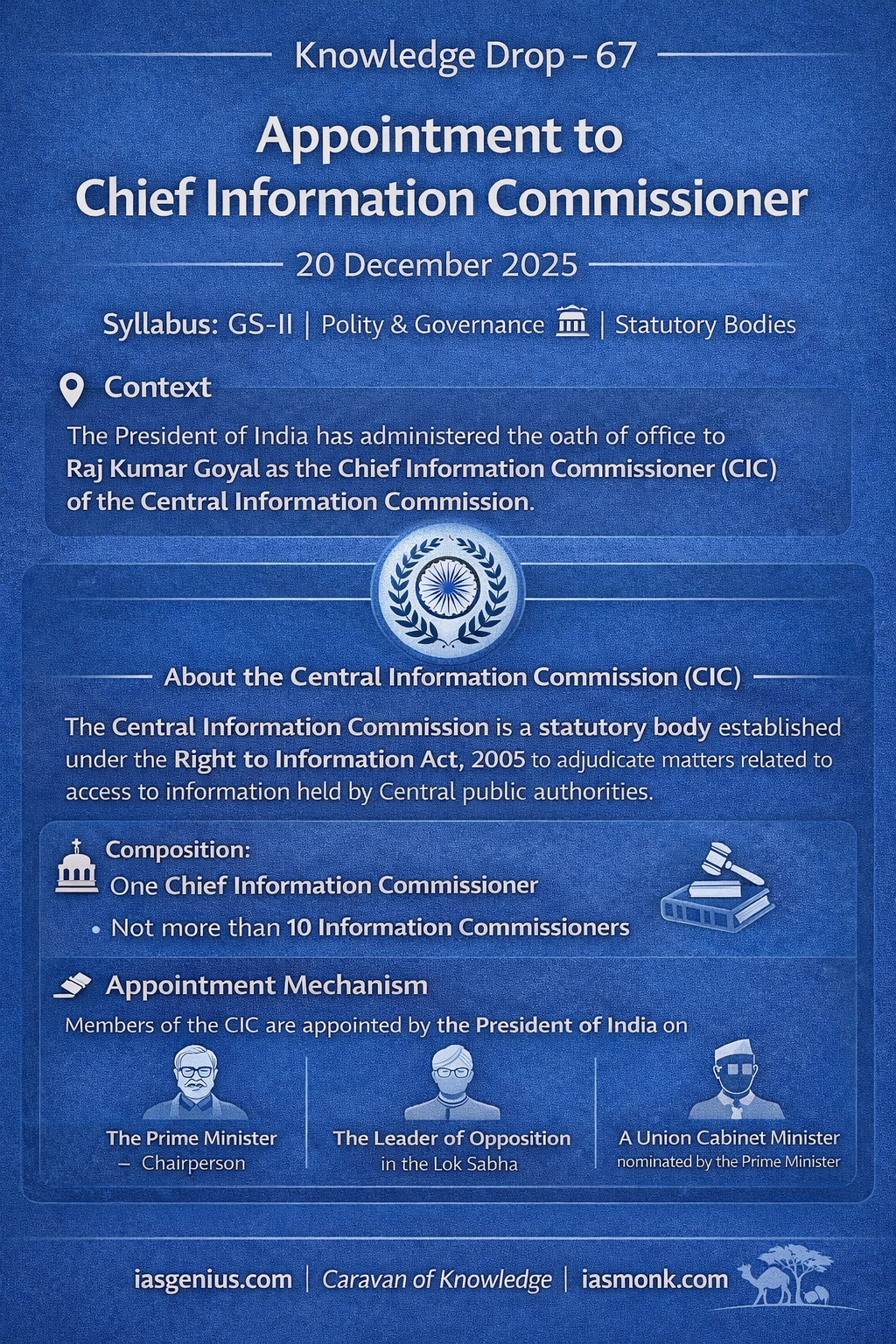
The President of India has administered the oath of office to Raj Kumar Goyal as the Chief Information Commissioner (CIC) of the Central Information Commission.
🔎 About the Central Information Commission (CIC)
The Central Information Commission is a statutory body established under the Right to Information Act, 2005 to adjudicate matters related to access to information held by Central public authorities.
- Composition:
- One Chief Information Commissioner
- Not more than 10 Information Commissioners
🧩 Appointment Mechanism
Members of the CIC are appointed by the President of India on the recommendation of a committee consisting of:
- The Prime Minister – Chairperson
- The Leader of Opposition in the Lok Sabha
- A Union Cabinet Minister nominated by the Prime Minister
This structure is intended to ensure bipartisan oversight in appointments.
⏳ Term of Office
- The Chief Information Commissioner and Information Commissioners hold office for a term of three years
- The term begins from the date on which the official enters upon office
📌 Jurisdiction
- The jurisdiction of the Central Information Commission extends over all Central Public Authorities
- It hears:
- Appeals against decisions of Central Public Information Officers (CPIOs)
- Complaints relating to denial or obstruction of information
👤 Eligibility Criteria (Section 12(5), RTI Act, 2005)
The CIC and Information Commissioners must:
- Be persons of eminence in public life
- Possess wide knowledge and experience in:
- Law
- Science and technology
- Social service
- Management
- Journalism or mass media
- Administration and governance
Disqualifications:
- Cannot be:
- A Member of Parliament
- A Member of a State Legislature or Union Territory Legislature
- Must not:
- Hold any office of profit
- Be connected with any political party
- Carry on any business or profession
⚖️ Powers and Functions
While conducting inquiries, the Commission enjoys powers equivalent to a civil court, including:
- Summoning and enforcing attendance of persons
- Compelling oral or written evidence on oath
- Requiring discovery and inspection of documents
- Receiving evidence on affidavit
- Requisitioning public records from any court or office
- Issuing summons for examination of witnesses or documents
📂 Access to Records
- During inquiry, the Commission may examine any record under the control of a public authority
- No record can be withheld from the Commission on any ground
🔒 Binding Nature of Decisions
- Decisions of the Central Information Commission are final and binding
- They play a crucial role in enforcing:
- Transparency
- Accountability
- Citizens’ right to information
🌀 IAS Monk Whisper
Transparency is not granted by power—it is compelled by institutions that answer only to the Constitution and the citizen.
Target IAS-2026+: Highly Expected Prelims MCQs :
📌 Prelims Practice MCQs
Topic:
MCQ 1 | TYPE 1 — How Many Statements Are Correct?
Consider the following statements regarding the Central Information Commission (CIC):
1)The Central Information Commission is a statutory body established under the Right to Information Act, 2005.
2)The CIC consists of a Chief Information Commissioner and exactly ten Information Commissioners.
3)The jurisdiction of the CIC extends over all Central Public Authorities.
4)The decisions of the CIC are advisory in nature and not binding.
How many of the above statements are correct?
(a)Only one
(b)Only two
(c)Only three
(d)All four
🌀 Didn’t get it? Click here (▸) for the Correct Answer & Explanation.
🟩 Correct Answer: (b)Only two
🧠 Explanation:
1)✅Correct.The CIC is a statutory body under the RTI Act, 2005.
2)❌Incorrect.The Commission consists of the CIC and not more than ten Information Commissioners.
3)✅Correct.Its jurisdiction covers all Central Public Authorities.
4)❌Incorrect.The decisions of the CIC are final and binding.
MCQ 2 | TYPE 2 — Two-Statement Type
Consider the following statements:
Statement I:The Chief Information Commissioner is appointed by the President of India.
Statement II:The appointment is made solely on the advice of the Prime Minister.
Which of the statements given above is/are correct?
(a)Statement I only
(b)Statement II only
(c)Both Statement I and Statement II
(d)Neither Statement I nor Statement II
🌀 Didn’t get it? Click here (▸) for the Correct Answer & Explanation.
🟩 Correct Answer: (a)Statement I only
🧠 Explanation:
1)✅Correct.The President appoints the CIC.
2)❌Incorrect.The appointment is based on recommendations of a committee, not solely the Prime Minister.
MCQ 3 | TYPE 3 — Code-Based Statement Selection
Which of the following are members of the committee that recommends appointments to the Central Information Commission?
1)Prime Minister of India
2)Leader of Opposition in the Lok Sabha
3)Chief Justice of India
4)A Union Cabinet Minister nominated by the Prime Minister
Select the correct answer using the code given below:
(a)1,2 and 4 only
(b)1 and 3 only
(c)2,3 and 4 only
(d)1,2,3 and 4
🌀 Didn’t get it? Click here (▸) for the Correct Answer & Explanation.
🟩 Correct Answer: (a)1,2 and 4 only
🧠 Explanation:
1)✅Correct.The Prime Minister is the Chairperson of the committee.
2)✅Correct.The Leader of Opposition in Lok Sabha is a member.
3)❌Incorrect.The Chief Justice of India has no role in this committee.
4)✅Correct.A Union Cabinet Minister nominated by the Prime Minister is included.
MCQ 4 | TYPE 4 — Direct Factual Question
What is the term of office of the Chief Information Commissioner under the RTI Act, 2005?
(a)Five years or until attaining the age of 65 years
(b)Three years from the date of entering office
(c)Six years from the date of appointment
(d)Three years or until attaining the age of 62 years
🌀 Didn’t get it? Click here (▸) for the Correct Answer & Explanation.
🟩 Correct Answer: :(b)Three years from the date of entering office
🧠 Explanation:
The RTI Act provides a fixed tenure of three years for the CIC and Information Commissioners.
MCQ 5 | TYPE 5 — UPSC 2025 Linkage Reasoning Format (I, II, III)
Consider the following statements:
1)The Right to Information Act, 2005 created an independent statutory authority to enforce transparency.
2)The Central Information Commission was vested with powers equivalent to those of a civil court during inquiries.
3)The decisions of the Central Information Commission are final and binding on public authorities.
Which of the above statements best explains the logical linkage?
(a)Statement 1 is the cause, Statements 2 and 3 are the effects
(b)Statements 2 and 3 contradict Statement 1
(c)Statement 3 alone explains Statements 1 and 2
(d)All three statements are unrelated
🌀 Didn’t get it? Click here (▸) for the Correct Answer & Explanation.
🟩 Correct Answer: :(a)Statement 1 is the cause, Statements 2 and 3 are the effects
🧠 Explanation:
1)✅Correct.The RTI Act establishes the institutional framework for transparency.
2)✅Correct.Civil-court-like powers enable effective enforcement.
3)✅Correct.Binding decisions ensure compliance by public authorities.