







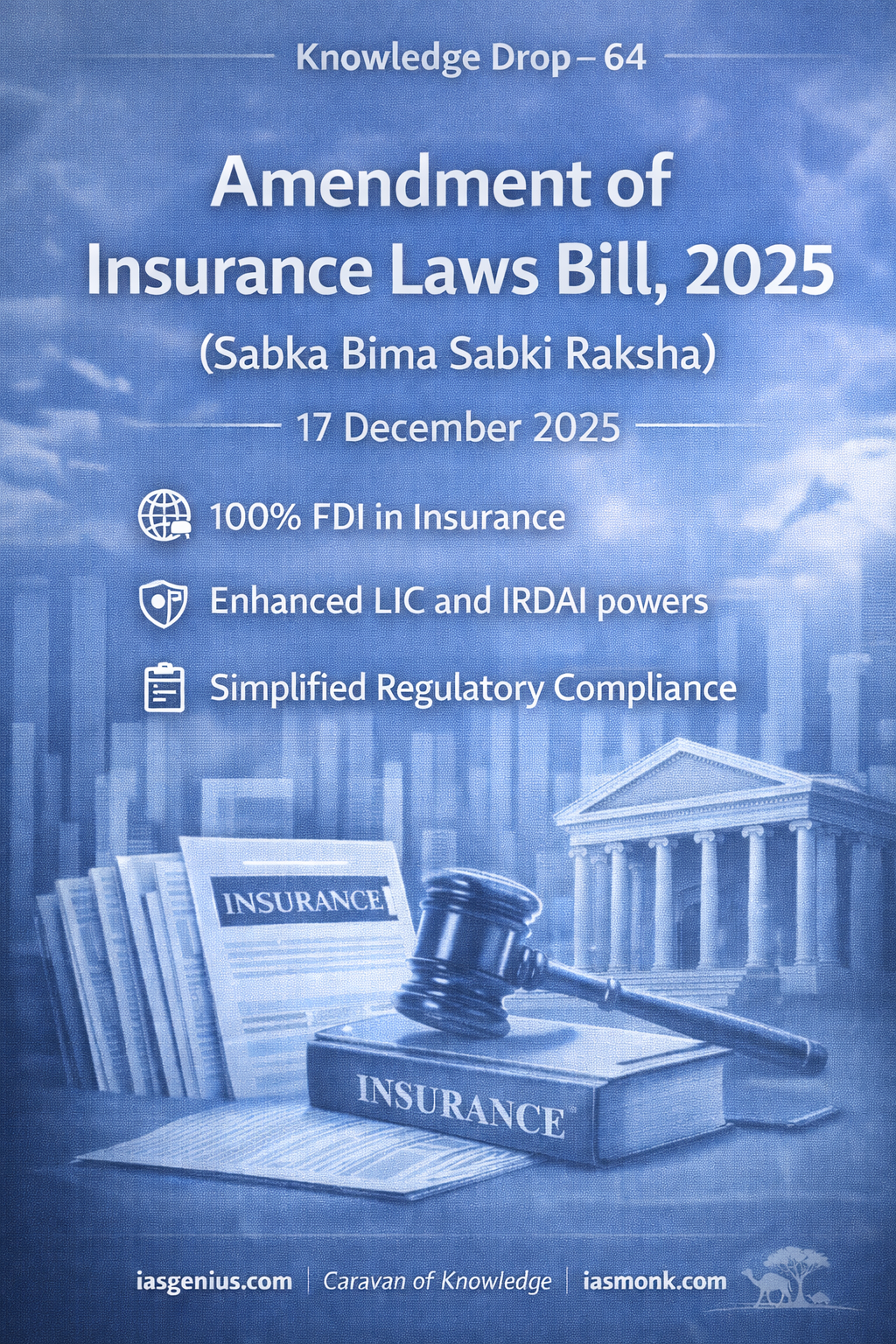
🌑Knowledge Drop – 64: Amendment of Insurance Laws Bill, 2025 (Sabka Bima Sabki Raksha)| For prelims: Highly expected MCQs | For Mains, All G.S Papers: High Quality Essays on iasmonk.com
Amendment of Insurance Laws Bill, 2025 (Sabka Bima Sabki Raksha)
Post Date: 17 December 2025
Syllabus:
GS-II | Governance 🏛️
GS-III | Economy & Financial Sector 💼
📍 Context
The Union Cabinet has approved the Sabka Bima Sabki Raksha (Amendment of Insurance Laws) Bill, 2025, aimed at overhauling India’s insurance regulatory framework to improve coverage, investment, and governance.
🔎 About the Bill
The Bill proposes amendments to three core legislations:
- Insurance Act, 1938
- Life Insurance Corporation Act, 1956
- IRDAI Act, 1999
Core Objective:
Modernisation of the insurance sector, wider coverage, enhanced competition, and stronger regulatory oversight in line with Insurance for All by 2047.
🧩 Major Features of the Bill
1️⃣ 100% FDI in Insurance
- Raises FDI cap from 74% to 100% in Indian insurance companies 🌍
- Expected to attract stable, long-term foreign capital
- Supports expansion of insurance penetration and density
2️⃣ Easing Entry for Foreign Reinsurers
- Net Owned Fund requirement reduced from ₹5,000 crore to ₹1,000 crore
- Encourages entry of more global reinsurers
- Enhances domestic reinsurance capacity
- Reduces dominance of General Insurance Corporation of India (GIC Re)
3️⃣ Greater Operational Freedom for LIC
- Life Insurance Corporation of India (LIC) can now:
- Set up new zonal offices without prior government approval
- Enables:
- Faster expansion
- Administrative efficiency
- Improved regional supervision
4️⃣ Enhanced Powers for IRDAI
- Insurance Regulatory and Development Authority of India (IRDAI) gains stronger enforcement powers ⚖️
- Can disgorge wrongful gains earned by insurers or intermediaries
- Aligns IRDAI’s powers closer to SEBI’s regulatory framework
5️⃣ One-Time Registration System
- Introduces a single, one-time registration for insurance intermediaries
- Eliminates repetitive approvals
- Simplifies compliance and reduces transaction costs
6️⃣ Ease of Doing Business Measures
- Threshold for IRDAI approval in transfer of paid-up equity raised from 1% to 5%
- Facilitates smoother share transfers
- Reduces regulatory bottlenecks
7️⃣ Rationalised Penalty Framework
- Clear and objective criteria for penalties
- Ensures:
- Transparency
- Consistency
- Predictable enforcement
⚠️ Key Omissions in the Bill
❌ No Composite Licensing
- Insurers still restricted to:
- Life insurance or
- General insurance
- Prevents integrated insurance offerings
- Ignores long-standing industry demand for composite licences
❌ No Relaxation in Minimum Capital Requirements
- Entry norms retained:
- ₹100 crore for insurers
- ₹200 crore for reinsurers
- Continues to deter:
- Small
- Regional
- Niche insurers
❌ Several Earlier Reform Proposals Dropped
- No permission for:
- Insurers to distribute other financial products
- Agents to sell policies of multiple insurers
- Limits:
- Consumer choice
- Distribution efficiency
- Revenue diversification
❌ Silence on Captive Insurance Companies
- No provision for large corporates to set up captive insurers
- Keeps India dependent on offshore or external risk-management structures
- Missed opportunity to deepen domestic risk-management capacity
🌟 Significance of the Bill
- Major FDI reform: 100% foreign ownership could unlock large capital inflows
- Global best practices: Access to advanced underwriting, digital claims, and risk-assessment tools
- Boost to competition: Increased innovation, efficiency, and customer-centric insurance products
- Governance upgrade: Stronger regulator with clearer enforcement authority
🌀 IAS Monk Whisper
Insurance is not merely protection against risk; it is a quiet promise of stability that allows economies and individuals to dare, build, and grow.
Target IAS-2026+: Highly Expected Prelims MCQs :
📌 Prelims Practice MCQs
Topic:
MCQ 1 | TYPE 1 — How Many Statements Are Correct?
Consider the following statements regarding the Sabka Bima Sabki Raksha (Amendment of Insurance Laws) Bill, 2025:
1)The Bill proposes to raise the FDI limit in insurance companies from 74% to 100%.
2)Foreign reinsurers will be required to maintain Net Owned Funds of at least ₹5,000 crore.
3)The Bill seeks to simplify compliance for insurance intermediaries through a one-time registration system.
4)The Bill introduces clearer criteria for levying penalties on insurers and intermediaries.
How many of the above statements are correct?
(a)Only one
(b)Only two
(c)Only three
(d)All four
🌀 Didn’t get it? Click here (▸) for the Correct Answer & Explanation.
🟩 Correct Answer: c)Only three
🧠 Explanation:
1)✅Correct.The FDI limit is proposed to be raised to 100%.
2)❌Incorrect.Net Owned Fund requirement for foreign reinsurers is proposed to be reduced to ₹1,000 crore.
3)✅Correct.A one-time registration system is proposed to ease compliance.
4)✅Correct.Clear criteria for penalties are introduced to improve enforcement consistency.
MCQ 2 | TYPE 2 — Two-Statement Type
Consider the following statements:
Statement I:The Amendment Bill empowers IRDAI to disgorge wrongful gains made by insurers or intermediaries.
Statement II:Such powers bring IRDAI’s enforcement capabilities closer to those of SEBI.
Which of the statements given above is/are correct?
(a)Statement I only
(b)Statement II only
(c)Both Statement I and Statement II
(d)Neither Statement I nor Statement II
🌀 Didn’t get it? Click here (▸) for the Correct Answer & Explanation.
🟩 Correct Answer: (c)Both Statement I and Statement II
🧠 Explanation:
1)✅ True – Statement I is correct as the Bill grants IRDAI disgorgement powers.
2)❌ False –Statement II is correct because SEBI already exercises similar powers.
MCQ 3 | TYPE 3 — Code-Based Statement Selection
Which of the following are major features of the Amendment of Insurance Laws Bill, 2025?
1)Enhanced operational autonomy for LIC
2)Increase in minimum capital requirements for new insurers
3)Easing norms for entry of foreign reinsurers
4)Higher threshold for IRDAI approval in equity transfers
Select the correct answer using the code given below:
(a)1,3 and 4 only
(b)1 and 2 only
(c)2,3 and 4 only
(d)1,2,3 and 4
🌀 Didn’t get it? Click here (▸) for the Correct Answer & Explanation.
🟩 Correct Answer: (a)1,3 and 4 only
🧠 Explanation:
1)✅Correct.LIC is given greater operational freedom.
2)❌Incorrect.Minimum capital requirements remain unchanged.
3)✅Correct.Entry norms for foreign reinsurers are eased.
4)✅Correct.Equity transfer approval threshold is raised from 1% to 5%.
MCQ 4 | TYPE 4 — Direct Factual Question
The primary objective of raising the FDI limit to 100% in the insurance sector is to:
(a)Reduce government ownership in public sector insurers
(b)Attract stable long-term foreign capital and expand insurance coverage
(c)Eliminate domestic insurers from the market
(d)Replace the banking sector as the main source of financial intermediation
🌀 Didn’t get it? Click here (▸) for the Correct Answer & Explanation.
🟩 Correct Answer: (b)Attract stable long-term foreign capital and expand insurance coverage
🧠 Explanation:
Higher FDI is expected to bring capital, technology, and best practices to support Insurance for All by 2047.
MCQ 5 | TYPE 5 — UPSC 2025 Linkage Reasoning Format (I, II, III)
Consider the following statements:
1)India aims to achieve Insurance for All by 2047.
2)Achieving this requires greater capital, competition, and regulatory efficiency in the insurance sector.
3)The Amendment of Insurance Laws Bill, 2025 introduces reforms such as higher FDI, stronger regulation, and ease of doing business.
Which of the above statements best explains the logical linkage?
(a)Statement 1 is the cause, Statements 2 and 3 are the effects
(b)Statements 2 and 3 contradict Statement 1
(c)Statement 3 alone explains Statements 1 and 2
(d)All three statements are unrelated
🌀 Didn’t get it? Click here (▸) for the Correct Answer & Explanation.
🟩 Correct Answer: (a)Statement 1 is the cause, Statements 2 and 3 are the effects
🧠 Explanation:
Statement 1 sets the national coverage goal.
Statement 2 identifies structural requirements.
Statement 3 represents the policy response designed to meet those requirements.