
🌑Knowledge Drop – 61: India–Russia at 25: A Strategic Partnership That Refuses to Fracture| For prelims: Highly expected MCQs | For Mains, All G.S Papers:High Quality Essays
Post : 14 Dec 2025
India–Russia at 25: A Strategic Partnership That Refuses to Fracture 🇮🇳🤝🇷🇺
Syllabus: GS2 | International Relations
Context
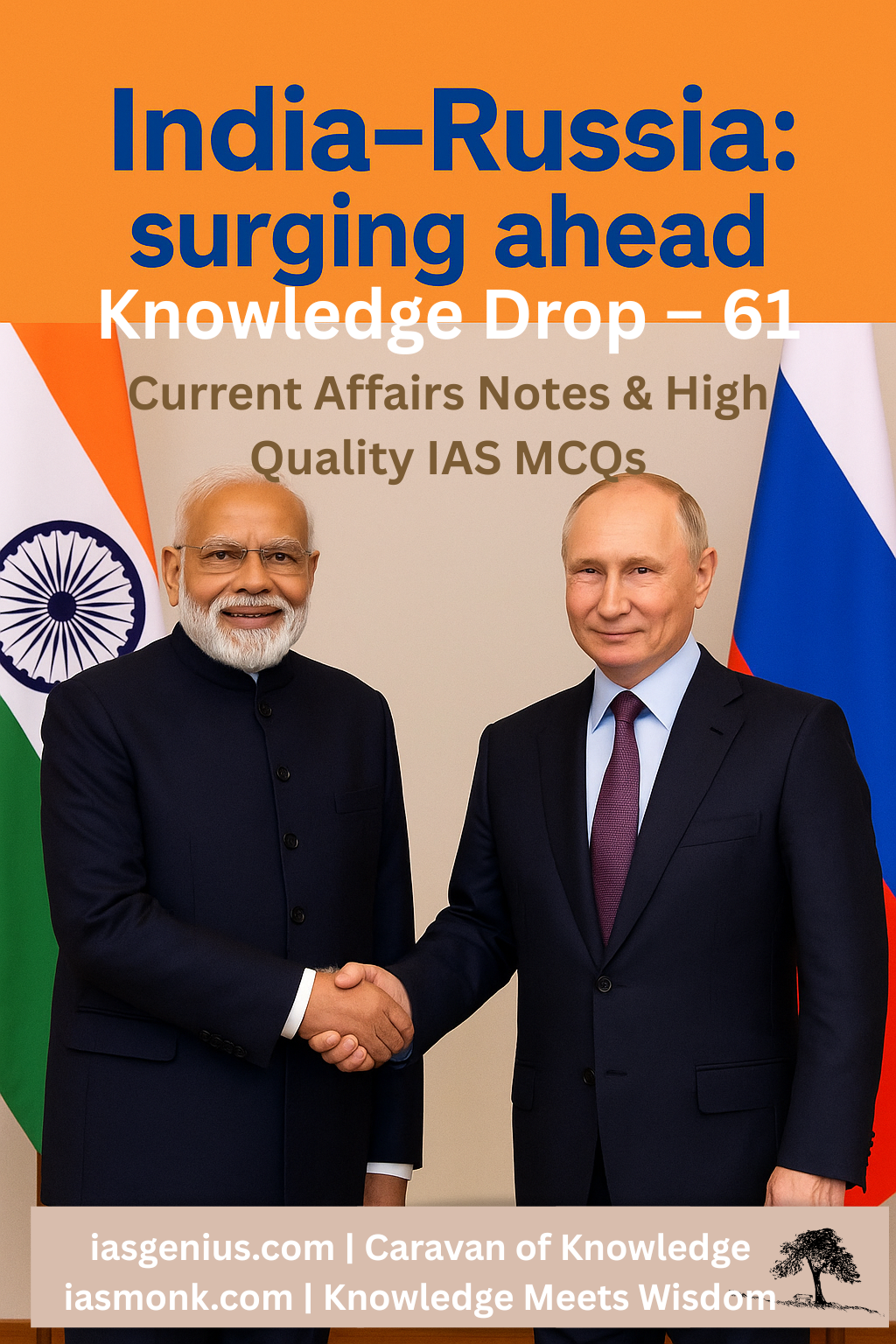
India and Russia convened the 23rd India–Russia Annual Summit, marking 25 years of the Declaration on Strategic Partnership (2000). The summit reaffirmed the resilience of bilateral ties amid global polarisation, sanctions, and shifting power equations.
Key Outcomes of the Summit 📜
1️⃣ Economic Programme 2030
- Adoption of the Programme for Development of Strategic Areas of India–Russia Economic Cooperation till 2030.
- Focus on technology, manufacturing, agriculture, pharmaceuticals, and investment.
2️⃣ Trade Expansion Target
- Reaffirmed goal of USD 100 billion bilateral trade by 2030.
- Commitment to address tariff and non-tariff barriers for smoother trade flows.
3️⃣ Strategic Agreements
- 16 agreements signed across defence, economy, healthcare, academics, culture, and media.
- Push towards joint R&D, co-development, and Make in India defence manufacturing.
4️⃣ Free Trade Agreement Momentum
- Accelerated discussions for India–Eurasian Economic Union (EAEU) FTA, covering Russia, Belarus, Armenia, Kazakhstan, and Kyrgyzstan.
5️⃣ People-to-People Connectivity
- Introduction of free 30-day e-tourist visas and group tourist visas for Russian citizens.
6️⃣ Multilateral Cooperation
- Russia agreed to join the International Big Cat Alliance.
- Reiterated coordination in BRICS, SCO, G20, and other global platforms.
Why This Visit Matters for India 🔍
Strategic Autonomy
- Hosting Russia despite Western pressure reinforces India’s independent foreign policy doctrine.
- Signals refusal to be boxed into binary geopolitical camps.
Defence & Security Continuity
- Russia supplies 60–70% of India’s defence inventory.
- Cooperation evolving from buyer–seller to co-development and indigenous production.
Energy Security
- Russia remains India’s largest crude oil supplier, offering discounted supplies despite sanctions.
- India balances energy pragmatism with market-based procurement decisions.
Shielding India from US Tariff Pressures 🛡️
Energy Cost Advantage
- Discounted Russian oil stabilises India’s energy basket amid global price volatility.
Market Diversification
- Russia and the Eurasian region reduce India’s over-dependence on US and EU markets.
Connectivity & Logistics
- Projects like:
- International North–South Transport Corridor (INSTC)
- Chennai–Vladivostok Maritime Corridor
- Northern Sea Route
- These reduce transport costs and offset tariff-driven competitiveness losses.
Currency & Payment Mechanisms
- Rupee–Rouble settlements reduce exposure to dollar-based sanctions and restrictions.
Strategic Signalling
- Strong India–Russia ties improve India’s bargaining position with the US on trade and tariffs.
The Larger Message 🌐
Marking 25 years of strategic partnership, India–Russia ties have survived:
- Post-Cold War realignments
- Sanctions regimes
- Global conflicts and supply-chain disruptions
This continuity shows the relationship is structural, not transactional.
Conclusion
The India–Russia partnership strengthens India’s energy security, trade diversification, and strategic autonomy at a time of intense geopolitical and tariff pressures.
By deepening cooperation with Russia while engaging all major powers, India preserves its core principle: multi-alignment without dependence.
Target IAS-2026+: Highly Expected Prelims MCQs :
📌 Prelims Practice MCQs
Topic: India–Russia at 25: A Strategic Partnership That Refuses to Fracture
MCQ 1 | TYPE 1 — How Many Statements Are Correct?
Consider the following statements regarding the India–Russia Strategic Partnership:
1)The Declaration on Strategic Partnership between India and Russia was signed in the year 2000.
2)The 23rd India–Russia Annual Summit marked 25 years of this declaration.
3)Russia is currently India’s largest defence supplier, accounting for more than half of India’s defence inventory.
4)India–Russia relations are formally described as a “Comprehensive Strategic Partnership”.
How many of the above statements are correct?
A)Only one
B)Only two
C)Only three
D)All four
🌀 Didn’t get it? Click here (▸) for the Correct Answer & Explanation.
🟩 Correct Answer: C) Only three
🧠 Explanation:
1)✅ True – Declaration signed in 2000.
2)✅ True – 2025 marks 25 years.
3)✅ True – Russia supplies ~60–70% of India’s defence inventory.
4)❌ False – The formal term is “Special and Privileged Strategic Partnership”.
MCQ 2 | TYPE 2 — Two-Statement Type
Consider the following statements:
1)India’s hosting of the Russian President despite Western pressure reflects its policy of strategic autonomy.
2)India’s foreign policy doctrine mandates alignment with one major power bloc at a time.
Which of the above statements is/are correct?
A)Only 1 is correct
B)Only 2 is correct
C)Both are correct
D)Neither is correct
🌀 Didn’t get it? Click here (▸) for the Correct Answer & Explanation.
🟩 Correct Answer: A) Only 1 is correct
🧠 Explanation:
1)✅ True – India follows independent, interest-based diplomacy.
2)❌ False – India follows multi-alignment, not bloc alignment.
MCQ 3 | TYPE 3 — Code-Based Statement Selection
Consider the following statements regarding the India–Russia Economic Cooperation Programme 2030:
1)It aims to expand cooperation in manufacturing, technology, agriculture, and pharmaceuticals.
2)It sets a revised bilateral trade target of USD 100 billion by 2030.
3)It focuses exclusively on defence trade between the two countries.
Which of the above statements are correct?
A)1 and 2 only
B)2 and 3 only
C)1 and 3 only
D)1, 2 and 3
🌀 Didn’t get it? Click here (▸) for the Correct Answer & Explanation.
🟩 Correct Answer: A) 1 and 2 only
🧠 Explanation:
1)✅ True – Programme 2030 diversifies cooperation.
2)✅ True – Trade target revised to USD 100 billion.
3)❌ False – Defence is only one component, not exclusive.
MCQ 4 | TYPE 4 — Direct Factual Question
Russia agreed during the 23rd India–Russia Annual Summit to join which India-led global initiative?
A)Coalition for Disaster Resilient Infrastructure
B)International Solar Alliance
C)International Big Cat Alliance
D)Global Biofuel Alliance
🌀 Didn’t get it? Click here (▸) for the Correct Answer & Explanation.
🟩 Correct Answer: C) International Big Cat Alliance
🧠 Explanation:
Russia adopted the framework agreement to join India’s International Big Cat Alliance, signalling ecological cooperation beyond geopolitics.
MCQ 5 | TYPE 5 — UPSC 2025 Linkage Reasoning Format (I, II, III)
Consider the following statements:
Statement I:
India–Russia partnership helps India mitigate economic and strategic pressures arising from US tariff actions.
Statement II:
Energy security, rupee–ruble trade, alternative markets, and logistics corridors with Russia reduce India’s vulnerability to US-centric trade disruptions.
Which one of the following is correct?
A)Both Statement I and Statement II are correct and Statement II explains Statement I
B)Both Statement I and Statement II are correct but Statement II does not explain Statement I
C)Statement I is correct but Statement II is incorrect
D)Statement I is incorrect but Statement II is correct
🌀 Didn’t get it? Click here (▸) for the Correct Answer & Explanation.
🟩 Correct Answer: A)
🧠 Explanation:
✅ Russia provides discounted energy, alternative markets, logistics corridors, and currency mechanisms.
✅ These factors directly explain how India cushions tariff-related and geopolitical pressures.