




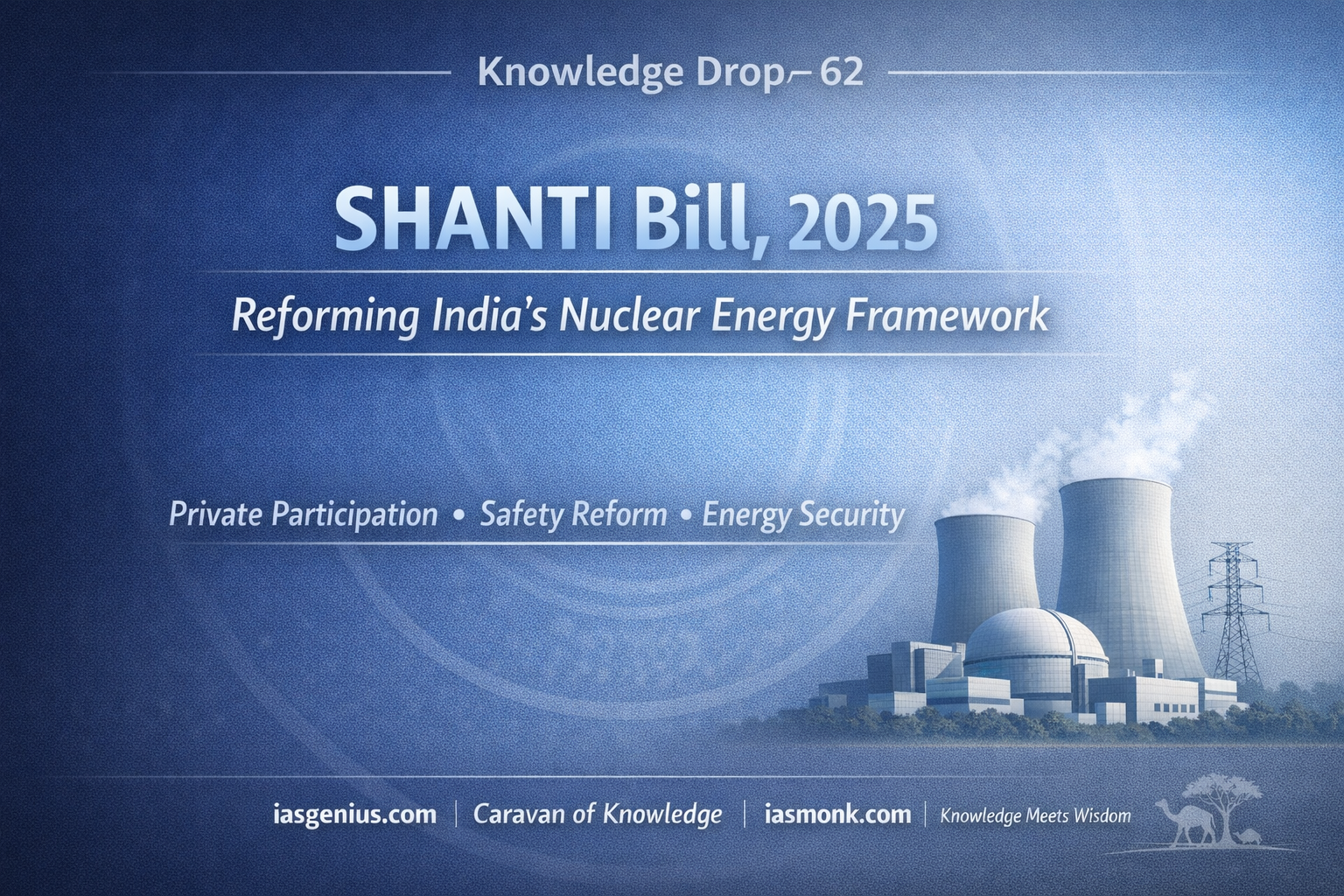
🌑Knowledge Drop – 62: Cabinet Approves SHANTI Bill (Atomic Energy Bill, 2025)| For prelims: Highly expected MCQs | For Mains, All G.S Papers:High Quality Essays
Cabinet Approves SHANTI Bill (Atomic Energy Bill, 2025)
Post Date: 15 December 2025
Syllabus: GS-III | Energy Security | Nuclear Technology ⚛️
📍 Context
The Union Cabinet has approved the Atomic Energy Bill, 2025, titled SHANTI — Sustainable Harnessing of Advancement of Nuclear Technology for India.
The Bill seeks to create a unified, modern, and future-ready legal framework for India’s nuclear sector while retaining strategic state control.
🔎 Background: Why Reform Was Needed
Traditionally, nuclear power generation in India has been restricted to state entities such as:
- Nuclear Power Corporation of India Ltd (NPCIL)
- Bharatiya Nabhikiya Vidyut Nigam (BHAVINI)
Private participation remained limited due to:
- The Atomic Energy Act, 1962, which centralised control
- The Civil Liability for Nuclear Damage Act, 2010, which imposed open-ended supplier liability, discouraging investment
🧩 Key Provisions of the SHANTI Bill
1️⃣ Partial Opening of the Nuclear Value Chain
- Allows private and global firms to participate in:
- Atomic mineral exploration
- Nuclear fuel fabrication
- Manufacturing of nuclear equipment and components
- Strategic domains remain sovereign:
- Reactor operations
- Weapons-related activities
2️⃣ Revamp of the Nuclear Liability Regime
To address long-standing investor concerns, the Bill proposes:
- Clear allocation of liability among:
- Operators
- Suppliers
- Government
- Introduction of insurance-backed liability caps
- Government support beyond a fixed liability threshold
This balances investor confidence with public compensation safeguards.
3️⃣ Independent Nuclear Safety Authority
- Establishment of a separate, autonomous safety regulator 🛡️
- Ends overlap between promotional and regulatory roles
- Strengthens:
- Transparency
- Public trust
- International credibility
4️⃣ Dedicated Nuclear Tribunal
- Creation of a specialised tribunal for nuclear disputes ⚖️
- Faster resolution and reduced legal ambiguity
- Enhances accountability and investor confidence
🎯 Strategic Rationale Behind the Reform
a) Nuclear Capacity Expansion
- India aims for 100 GW nuclear power capacity by 2047
- Requires:
- Large-scale capital infusion
- Advanced reactor technologies
- Faster project execution
b) Energy Transition
- Nuclear power provides clean, reliable baseload energy 🌱
- Complements intermittent renewables like solar and wind
- Supports India’s climate commitments by lowering fossil-fuel dependence
c) Enhancing Energy Security
- Diversifies the national energy mix
- Reduces exposure to fuel imports and geopolitical shocks
🛣️ Way Ahead
- Clear Regulatory Framework:
Strong oversight to ensure safety, accountability, and national security - Public-Private Partnerships (PPPs):
Government oversight with private-sector efficiency and innovation - Phased Implementation:
Pilot projects first, followed by calibrated large-scale expansion
🌀 IAS Monk Whisper
Nuclear energy, guided by restraint and wisdom, is not merely power generation — it is a covenant between science, safety, and future generations.
Target IAS-2026+: Highly Expected Prelims MCQs :
📌 Prelims Practice MCQs
Topic:
MCQ 1 | TYPE 1 — How Many Statements Are Correct?
Consider the following statements regarding the SHANTI Bill (Atomic Energy Bill, 2025):
1)The Bill allows private sector participation in atomic mineral exploration, nuclear fuel fabrication, and manufacturing of nuclear equipment.
2)Reactor operation and weapons-related nuclear activities are proposed to be opened to private and foreign companies.
3)The Bill proposes an insurance-backed liability cap to address investor concerns arising from nuclear accidents.
4)The establishment of an independent nuclear safety authority is intended to separate regulatory functions from promotional roles.
How many of the above statements are correct?
(a) Only one
(b) Only two
(c) Only three
(d) All four
🌀 Didn’t get it? Click here (▸) for the Correct Answer & Explanation.
🟩 Correct Answer: (c) Only three
🧠 Explanation:
1)✅Correct.The SHANTI Bill permits private participation in atomic mineral exploration, nuclear fuel fabrication, and manufacturing of nuclear equipment and components.
2)❌Incorrect.Reactor operation and weapons-related nuclear activities continue to remain under exclusive government control.
3)✅Correct.The Bill introduces insurance-backed liability caps to limit financial uncertainty for investors while ensuring compensation mechanisms.
4)✅Correct.An independent nuclear safety authority is proposed to separate safety regulation from promotional roles, enhancing transparency and credibility.
MCQ 2 | TYPE 2 — Two-Statement Type
Consider the following statements:
Statement I: The SHANTI Bill aims to create a unified and modern legal framework for India’s nuclear sector.
Statement II: The Bill completely replaces public sector control over nuclear reactor operations.
Which of the statements given above is/are correct?
(a) Statement I only
(b) Statement II only
(c) Both Statement I and Statement II
(d) Neither Statement I nor Statement II
🌀 Didn’t get it? Click here (▸) for the Correct Answer & Explanation.
🟩 Correct Answer: (a) Statement I only
🧠 Explanation:
1)✅ True – Statement I is correct as the Bill modernises and unifies nuclear legislation.
2)❌ False – Statement II is incorrect because reactor operations remain a sovereign function.
MCQ 3 | TYPE 3 — Code-Based Statement Selection
Which of the following provisions are associated with the SHANTI Bill?
1)Partial opening of the nuclear value chain
2)Establishment of a dedicated nuclear tribunal
3)Complete privatisation of nuclear power plants
4)Insurance-backed nuclear liability framework
Select the correct answer using the code given below:
(a)1,2 and 4 only
(b)1 and 3 only
(c)2 and 3 only
(d)1,2,3 and 4
🌀 Didn’t get it? Click here (▸) for the Correct Answer & Explanation.
🟩 Correct Answer: (a)1,2 and 4 only
🧠 Explanation:
1)✅Correct.Private participation is allowed in selected segments.
2)✅Correct.A dedicated nuclear tribunal is proposed.
3)❌Incorrect.Nuclear power plants are not fully privatised.
4)✅Correct.Insurance-backed liability caps are introduced.
MCQ 4 | TYPE 4 — Direct Factual Question
The primary objective of introducing insurance-backed liability caps under the SHANTI Bill is to:
(a)Transfer all nuclear accident liability to private operators
(b)Eliminate government responsibility in nuclear safety
(c)Address investor concerns while ensuring compensation
(d)Encourage nuclear weapons development
🌀 Didn’t get it? Click here (▸) for the Correct Answer & Explanation.
🟩 Correct Answer: (c) Address investor concerns while ensuring compensation
🧠 Explanation:
The liability reform balances investor confidence with victim compensation and government support beyond a threshold.
MCQ 5 | TYPE 5 — UPSC 2025 Linkage Reasoning Format (I, II, III)
Consider the following statements regarding nuclear energy reforms in India:
1)India has set a long-term target of significantly expanding nuclear power capacity to support energy security and climate goals.
2)Large-scale expansion of nuclear power requires private capital, advanced reactor technologies, and faster project execution.
3)The SHANTI Bill (Atomic Energy Bill, 2025) provides a modern legal and liability framework to enable such expansion.
Which of the above statements best explains the logical linkage?
(a)Statement 1 is the cause, Statements 2 and 3 are the effects
(b)Statements 1 and 2 are independent, Statement 3 is unrelated
(c)Statements 2 and 3 explain why Statement 1 is necessary
(d)All three statements are unrelated
🌀 Didn’t get it? Click here (▸) for the Correct Answer & Explanation.
🟩 Correct Answer: (a) Statement 1 is the cause, Statements 2 and 3 are the effects
🧠 Explanation:
1)Statement 1 sets the strategic objective of expanding nuclear power for energy security and climate commitments.
2)Statement 2 logically follows by identifying the requirements needed to achieve this expansion.
3)Statement 3 explains the policy and legal response, namely the SHANTI Bill, designed to enable those requirements.