











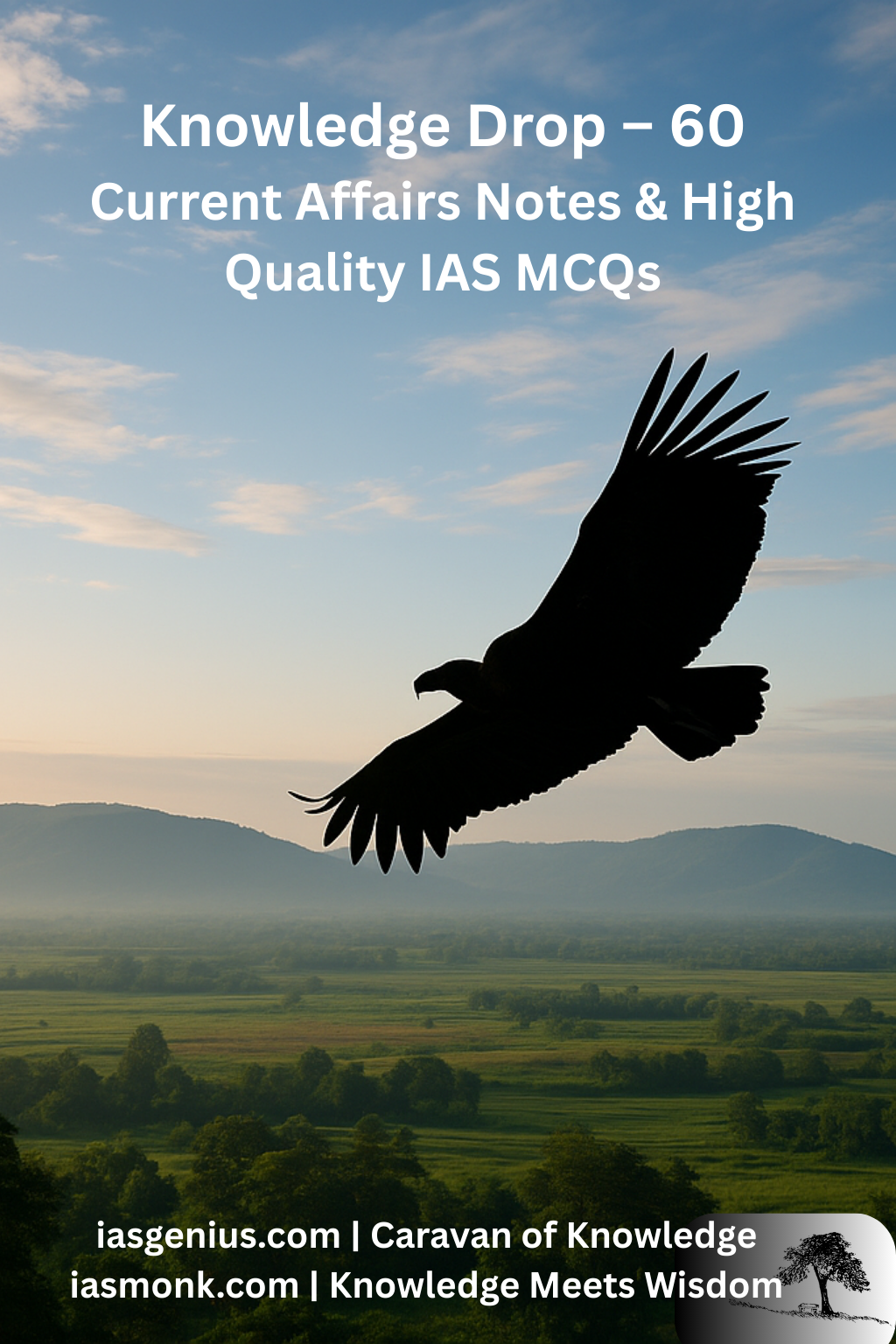
🌑Knowledge Drop – 60: Bringing Back the Sky’s Sanitation Workers| For prelims: Highly expected MCQs | For Mains, All G.S Papers:High Quality Essays
Post : 14 Dec 2025
🦅 Knowledge Drop-60 | Bringing Back the Sky’s Sanitation Workers
BNHS to Reintroduce Critically Endangered Vultures in Assam
Syllabus: GS-3 | Environment & Ecology
🌱 Context
The Bombay Natural History Society (BNHS) is set to reintroduce two critically endangered vulture species —
- Slender-billed Vulture (Gyps tenuirostris)
- White-rumped Vulture (Gyps bengalensis)
in Assam, marking a crucial step in restoring India’s collapsing vulture populations.
🦅 Why Vultures Matter
Vultures are not just birds; they are ecological sentinels.
- 🧬 Nature’s clean-up crew: By consuming infected carcasses, vultures destroy pathogens and prevent disease spread.
- ⚕️ Public health protectors: Their decline earlier led to a surge in feral dogs and rabies cases.
- 🕊️ Cultural significance: Essential to the Parsi community, which practices sky burials at the Towers of Silence.
- 🌍 Ecosystem balance: They accelerate nutrient recycling and prevent soil and water contamination.
🇮🇳 Vultures in India: A Snapshot
India hosts 9 vulture species, including:
Oriental White-backed, Long-billed, Slender-billed, Himalayan, Red-headed, Egyptian, Bearded, Cinereous, and Eurasian Griffon.
⚠️ Alarming fact:
India has lost over 99% of populations of White-rumped, Long-billed, and Slender-billed vultures since the 1990s.
⚠️ Major Threats
- ☠️ Diclofenac and other toxic NSAIDs used in livestock
- 🌳 Loss of nesting trees
- ⚡ Electrocution from power lines
- 🥩 Food scarcity and contaminated carcasses
- 🧪 Pesticide poisoning
✅ BNHS intervention: Promotion of vulture-safe alternatives like Meloxicam and Tolfenamic Acid.
📜 Legal & Conservation Status
Wildlife Protection Act, 1972
- Schedule I: Bearded, Long-billed, Slender-billed, Oriental White-backed
- Schedule IV: Remaining vulture species
🌍 IUCN Red List – Quick UPSC Note 📌
| IUCN Category | Meaning | Examples |
|---|---|---|
| Critically Endangered (CR) | Extremely high risk of extinction | White-rumped Vulture, Slender-billed Vulture, Red-headed Vulture |
| Endangered (EN) | Very high risk of extinction | Egyptian Vulture |
| Near Threatened (NT) | Close to qualifying for threatened status | Himalayan Vulture, Bearded Vulture, Cinereous Vulture |
| Least Concern (LC) | Widespread and stable | Eurasian Griffon |
👉 UPSC Tip: CR → EN → VU → NT → LC (descending order of risk)
🏛️ About Bombay Natural History Society (BNHS)
- 🗓️ Founded: 1883, Mumbai
- 🌿 One of India’s oldest and largest NGOs in biodiversity conservation
- 🎯 Mission: Conservation through research, education, and public awareness
- 🌍 Key role in species recovery programmes, including vultures
✨ Why This Move Matters
The BNHS reintroduction programme signals a shift from reactive conservation to ecological restoration.
Saving vultures is not about birds alone — it is about public health, cultural continuity, and ecological resilience.
🪶 When vultures return to the sky, ecosystems breathe easier.
Target IAS-2026+: Highly Expected Prelims MCQs :
📌 Prelims Practice MCQs
Topic: Bringing Back the Sky’s Sanitation Workers
MCQ 1 | TYPE 1 — How Many Statements Are Correct?
Consider the following statements regarding vultures in India:
1)Vultures act as natural scavengers that prevent the spread of infectious diseases.
2)India has lost nearly 99% of its population of some vulture species in recent decades.
3)Diclofenac used in livestock is harmless to vultures.
4)India hosts nine species of vultures.
How many of the above statements are correct?
A)Only one
B)Only two
C)Only three
D)All four
🌀 Didn’t get it? Click here (▸) for the Correct Answer & Explanation.
🟩 Correct Answer: C) Only three
🧠 Explanation:
1)✅ True – Vultures break the chain of disease transmission.
2)✅ True – India witnessed catastrophic declines since the 1990s.
3)❌ False – Diclofenac causes fatal kidney failure in vultures.
4)✅ True – India hosts nine, species of vultures.
MCQ 2 | TYPE 2 — Two-Statement Type
Consider the following statements:
1)Slender-billed and White-rumped vultures are classified as Critically Endangered by the IUCN.
2)Bombay Natural History Society (BNHS) is a government-owned statutory body.
Which of the above statements is/are correct?
A)Only 1 is correct
B)Only 2 is correct
C)Both are correct
D)Neither is correct
🌀 Didn’t get it? Click here (▸) for the Correct Answer & Explanation.
🟩 Correct Answer: A) Only 1 is correct
🧠 Explanation:
1)✅ True – Both species are Critically Endangered.
2)❌ False – BNHS is a non-governmental organization.
MCQ 3 | TYPE 3 — Code-Based Statement Selection
Consider the following statements regarding threats to vultures in India:
1)Use of Diclofenac in livestock
2)Loss of nesting trees
3)Electrocution from power lines
4)Expansion of vulture-safe NSAIDs
Which of the above are major threats to vulture populations?
A)1, 2 and 3 only
B)2 and 4 only
C)1 and 4 only
D)1, 2, 3 and 4
🌀 Didn’t get it? Click here (▸) for the Correct Answer & Explanation.
🟩 Correct Answer: A) 1, 2 and 3 only
🧠 Explanation:
1)✅ Diclofenac caused mass mortality.
2)✅ Nesting habitat loss affects breeding.
3)✅ Power lines cause fatal electrocution.
4)❌ Vulture-safe NSAIDs are a solution, not a threat.
MCQ 4 | TYPE 4 — Direct Factual Question
Which organisation is leading the reintroduction of critically endangered vultures in Assam?
A)Wildlife Institute of India
B)Bombay Natural History Society
C)National Biodiversity Authority
D)Central Zoo Authority
🌀 Didn’t get it? Click here (▸) for the Correct Answer & Explanation.
🟩 Correct Answer: B) Bombay Natural History Society
🧠 Explanation:
BNHS is spearheading captive breeding and reintroduction programmes for vultures in India.
MCQ 5 | TYPE 5 — UPSC 2025 Linkage Reasoning Format (I, II, III)
Consider the following statements:
Statement I:
India’s vulture population collapse had serious public health implications.
Statement II:
The decline of vultures led to an increase in carcass-borne pathogens and feral dog populations.
Which one of the following is correct?
A)Both Statement I and Statement II are correct and Statement II explains Statement I
B)Both Statement I and Statement II are correct but Statement II does not explain Statement I
C)Statement I is correct but Statement II is incorrect
D)Statement I is incorrect but Statement II is correct
🌀 Didn’t get it? Click here (▸) for the Correct Answer & Explanation.
🟩 Correct Answer: A)
🧠 Explanation:
✅ Loss of vultures disrupted ecological sanitation.
✅ Increase in carcasses boosted disease spread and stray dog numbers, explaining the public health crisis.