











🌑Knowledge Drop – 59: Capturing Carbon, Buying Time: India’s CCUS Roadmap for a Net-Zero Future | For Mains, All G.S Papers: High Quality Essays
13 Dec 2025
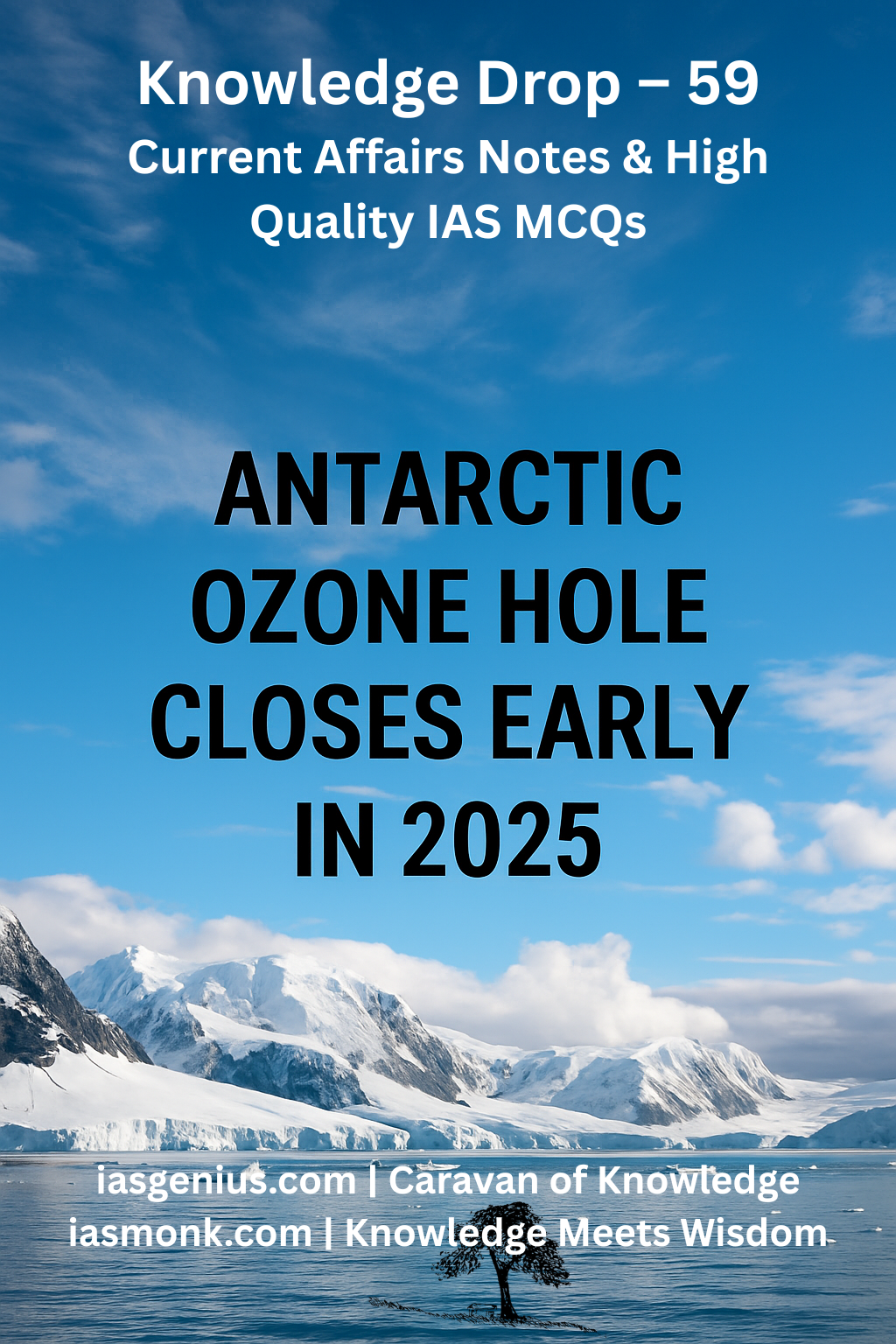
🌍 When the Sky Heals Itself: Antarctic Ozone Hole Closes Early in 2025
Syllabus: GS3 – Environment
🧊 Context
In a rare moment of ecological optimism, the Antarctic ozone hole that emerged in August 2025 closed earlier than its usual seasonal cycle, renewing confidence in global environmental cooperation even as the planet warms at record pace.
☁️ What Exactly Is the Ozone Hole?
The ozone hole refers to a seasonal thinning of the stratospheric ozone layer over Antarctica, first detected in 1985.
It is not an actual void, but a region where ozone concentration drops sharply, especially during Southern Hemisphere spring (August–October).
The ozone layer acts as Earth’s protective sunscreen, absorbing harmful UV-B radiation from the Sun.
⚗️ Why Does the Ozone Hole Form?
The phenomenon is driven by a deadly combination of chemistry and climate:
- Ozone-Depleting Substances (ODS):
Chlorofluorocarbons (CFCs), halons, and related chemicals release chlorine and bromine atoms in the stratosphere, which catalytically destroy ozone molecules. - Polar Stratospheric Clouds (PSCs):
Extreme Antarctic cold forms these clouds, accelerating ozone-destroying reactions. - Climate Change Interactions:
While the surface warms, the stratosphere cools, influencing ozone depletion dynamics and recovery timing.
🌱 Why Early Closure Matters
An early closure is a strong indicator of long-term ozone recovery, reflecting the declining concentration of ODS in the atmosphere.
Its significance spans multiple domains:
- Human Health:
Reduced UV-B exposure lowers risks of skin cancer, cataracts, and immune suppression. - Ecosystems:
Protects phytoplankton, the foundation of marine food webs, and stabilises agricultural productivity. - Climate Linkages:
Ozone recovery helps restore atmospheric circulation patterns in the Southern Hemisphere.
🌐 The Montreal Protocol: A Rare Global Success
- Montreal Protocol (1987):
A landmark treaty that phased out ozone-depleting substances globally. - Kigali Amendment (2016):
Extended controls to hydrofluorocarbons (HFCs), addressing climate impacts alongside ozone protection.
This coordinated action is widely regarded as the most successful environmental treaty in history.
🔮 What Lies Ahead
Scientists caution that ozone recovery, though promising, remains fragile.
Key priorities include:
- Strict enforcement of the Montreal Protocol
- Alignment of ozone protection with climate policies
- Adoption of sustainable, ozone-safe technologies
With continued vigilance, full ozone recovery is projected between 2060 and 2070.
🌎 Closing Note
The early healing of the Antarctic ozone layer proves a powerful lesson:
When science guides policy and nations cooperate, planetary wounds can heal.
Target IAS-2026+: Highly Expected Prelims MCQs :
📌 Prelims Practice MCQs
Topic:
MCQ 1 | TYPE 1 — How Many Statements Are Correct?
Consider the following statements regarding the Antarctic ozone hole:
1)The ozone hole is a permanent hole where ozone is completely absent.
2)It occurs seasonally over Antarctica during the Southern Hemisphere spring.
3)Polar stratospheric clouds play a role in accelerating ozone depletion.
4)The ozone hole was first discovered in the 21st century.
How many of the above statements are correct?
A)Only one
B)Only two
C)Only three
D)All four
🌀 Didn’t get it? Click here (▸) for the Correct Answer & Explanation.
🟩 Correct Answer: B) Only two
🧠 Explanation:
1)❌ False – It is a region of severe depletion, not total absence.
2)✅ True – Occurs mainly from August to October.
3)✅ True – PSCs accelerate ozone-destroying reactions.
4)❌ False – It was discovered in 1985.
MCQ 2 | TYPE 2 — Two-Statement Type
Consider the following statements:
1)Chlorofluorocarbons release chlorine atoms that catalytically destroy ozone molecules.
2)Surface warming directly increases ozone depletion in the stratosphere.
Which of the above statements is/are correct?
A)Only 1 is correct
B)Only 2 is correct
C)Both are correct
D)Neither is correct
🌀 Didn’t get it? Click here (▸) for the Correct Answer & Explanation.
🟩 Correct Answer: A) Only 1 is correct
🧠 Explanation:
1)✅ True – CFCs release chlorine that destroys ozone.
2)❌ False – Stratospheric cooling, not surface warming, influences ozone chemistry.
MCQ 3 | TYPE 3 — Code-Based Statement Selection
Consider the following statements regarding impacts of ozone depletion:
1)Increased UV-B radiation raises risks of skin cancer and cataracts.
2)Ozone depletion can disrupt atmospheric circulation in the Southern Hemisphere.
3)Ozone depletion has no impact on marine ecosystems.
Which of the above statements are correct?
A)1 and 2 only
B)2 and 3 only
C)1 and 3 only
D)1, 2 and 3
🌀 Didn’t get it? Click here (▸) for the Correct Answer & Explanation.
🟩 Correct Answer: A) 1 and 2 only
🧠 Explanation:
1)✅ True – UV-B affects human health.
2)✅ True – It alters wind and weather patterns.
3)❌ False – It harms phytoplankton and marine food chains.
MCQ 4 | TYPE 4 — Direct Factual Question
Which international agreement is primarily credited with the recovery of the ozone layer?
A)Paris Agreement
B)Kyoto Protocol
C)Montreal Protocol
D)Stockholm Convention
🌀 Didn’t get it? Click here (▸) for the Correct Answer & Explanation.
🟩 Correct Answer: C) Montreal Protocol
🧠 Explanation:
The Montreal Protocol (1987) phased out ozone-depleting substances globally and is regarded as the most successful environmental treaty.
MCQ 5 | TYPE 5 — UPSC 2025 Linkage Reasoning Format (I, II, III)
Consider the following statements:
Statement I:
The early closure of the Antarctic ozone hole in 2025 reflects long-term global environmental cooperation.
Statement II:
Global phase-out of ozone-depleting substances has significantly reduced stratospheric chlorine concentrations.
Which one of the following is correct?
A)Both Statement I and Statement II are correct and Statement II explains Statement I
B)Both Statement I and Statement II are correct but Statement II does not explain Statement I
C)Statement I is correct but Statement II is incorrect
D)Statement I is incorrect but Statement II is correct
🌀 Didn’t get it? Click here (▸) for the Correct Answer & Explanation.
🟩 Correct Answer: A)
🧠 Explanation:
✅ Reduced chlorine from ODS phase-out directly drives ozone recovery.
✅ This explains the early closure observed in 2025.