
🌑Knowledge Drop – 56: Open Seas, Shared Rules: India’s Resolve for a Rules-Based Indian Ocean | For Prelims: InDepth MCQs| For Mains, All G.S Papers: High Quality Essays
Post: 10 Dec 2025
🌊 Knowledge Drop – 56
Open Seas, Shared Rules: India’s Resolve for a Rules-Based Indian Ocean
10 December 2025
Syllabus: GS-3 | Internal Security, Maritime Security
Thematic Focus: Indian Ocean Region (IOR), Indo-Pacific, Naval Strategy
🌍 Context
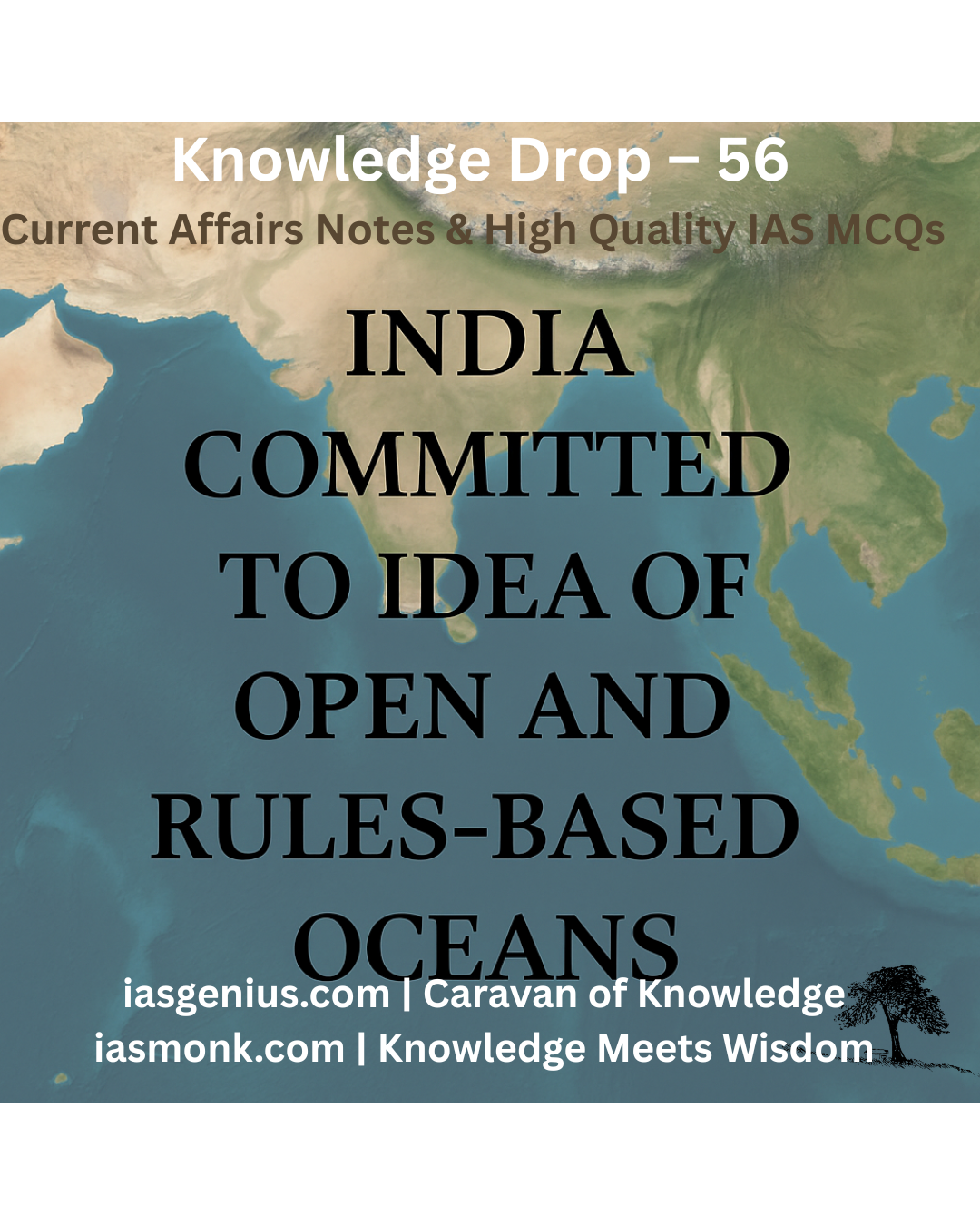
President Droupadi Murmu reaffirmed India’s commitment to keeping the oceans open, stable, secure, and rules-based, underlining the strategic centrality of the Indian Ocean Region (IOR) to global trade, energy security, and geopolitical stability.
India’s geography places it at the heart of the IOR, giving it both opportunity and responsibility to shape the maritime order of the 21st century.
⚓ Why the Indian Ocean Region Matters
🌐 Global Trade Artery
The Indian Ocean carries:
- ~50% of global container traffic
- ~80% of global seaborne oil trade
Vital chokepoints such as Hormuz, Bab-el-Mandeb, Malacca, and Lombok make the region indispensable to the world economy.
🧭 Geostrategic Theatre
The IOR links West Asia, Africa, South Asia, and Southeast Asia, making it a zone of intense competition among major powers — India, China, the US, and others.
🐟 Blue Economy Potential
- Supports ~15% of global fish catch
- Massive scope in shipping, fisheries, seabed mining, and marine biotechnology
🚢 Why Focus on the IOR Has Intensified
🔺 Indo-Pacific Construct
The Indian and Pacific Oceans are now treated as a single strategic continuum, elevating India’s maritime relevance.
🔺 Maritime Security Threats
- Piracy near the Horn of Africa
- Arms smuggling, narcotics trade, terror financing
- Illegal fishing and grey-zone operations
🔺 China’s Expanding Footprint
- Increased PLA Navy deployments
- Survey vessels collecting oceanographic data
- Strategic port development near India’s maritime boundaries
🇮🇳 India’s Strategic Maritime Response
🛟 Security Provider Role
India positions itself as:
- First responder in HADR operations
- Trusted partner for Maritime Domain Awareness (MDA)
🌊 Indo-Pacific Oceans Initiative (IPOI), 2019
Focus areas include:
- Maritime security
- Marine ecology
- Disaster management
- Connectivity and trade
🌱 MAHASAGAR Vision
“Mutual and Holistic Advancement for Security and Growth for All in the Region” — India’s re-articulated maritime doctrine.
⚓ Naval Modernisation
- Indigenous aircraft carrier INS Vikrant
- Advanced destroyers and submarines
- Enhanced surveillance and power projection
🤝 Multilateral Engagement
- IORA (trade, disaster management, blue economy)
- IONS (naval cooperation)
- QUAD (rules-based maritime order)
- Colombo Security Conclave (island security & capacity building)
⚠️ Key Challenges Ahead
🚨 Expansion of Chinese naval presence
🚨 Militarisation of Chinese-funded ports
🚨 Piracy and non-traditional maritime threats
🚨 Risk of erosion of freedom of navigation
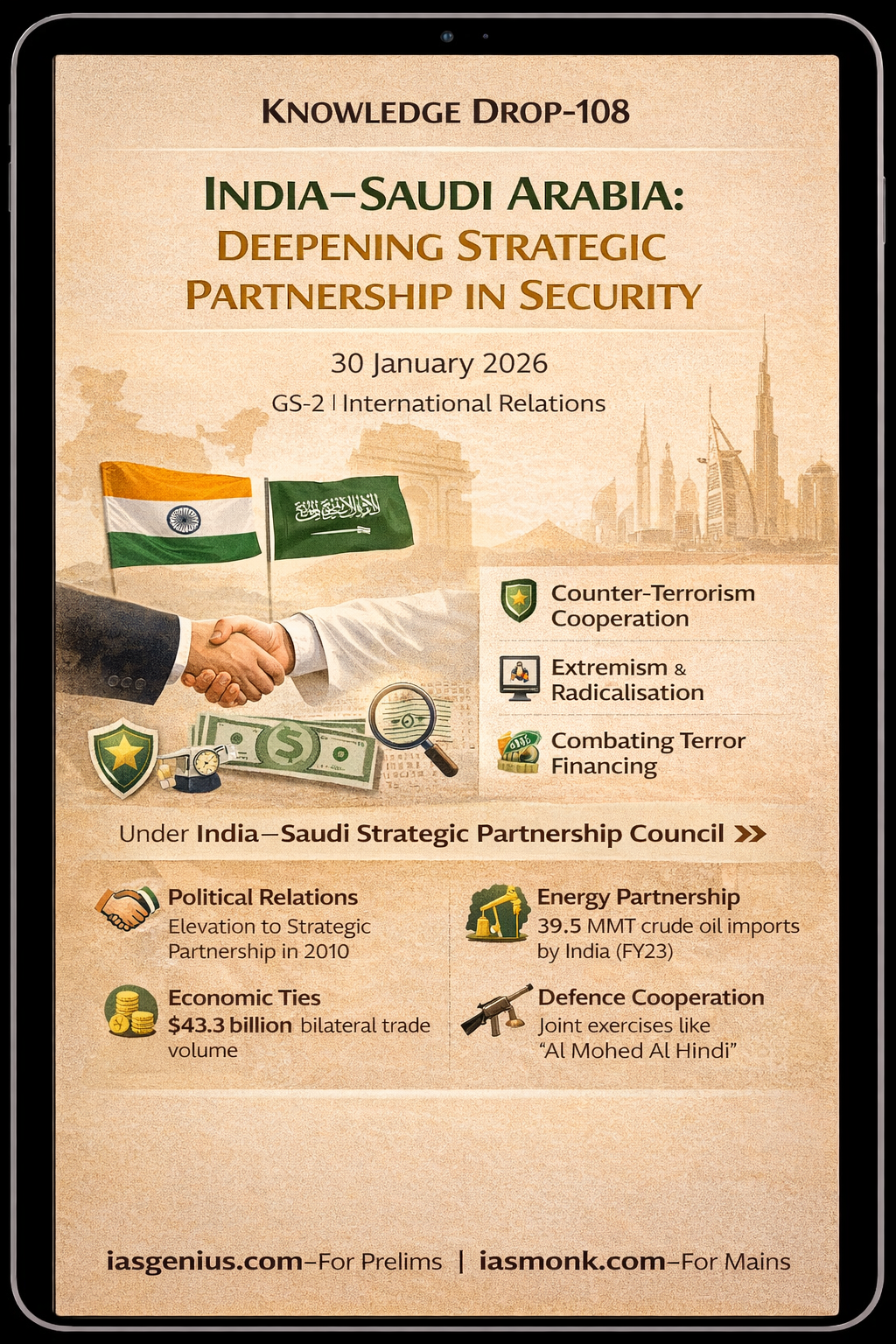
India has clearly stated that militarisation of the IOR is undesirable and undermines regional stability.
🧭 The Larger Message
For India, the Indian Ocean is not merely a neighbourhood — it is a strategic imperative.
An open and rules-based maritime order is essential for:
- National security
- Economic growth
- Energy security
- Global leadership
🌿 A Thought Spark — IAS Monk
“Oceans do not belong to power alone;
they belong to rules, restraint, and shared responsibility.
Those who keep the seas open, keep the future open.”
Target IAS-2026+: Highly Expected Prelims MCQs :
📌 Prelims Practice MCQs
Topic: Open Seas, Shared Rules: India’s Resolve for a Rules-Based Indian Ocean
MCQ 1 | TYPE 1 — How Many Statements Are Correct?
Consider the following statements regarding the Indian Ocean Region (IOR):
1)The Indian Ocean accounts for nearly one-fifth of the world’s total ocean area.
2)The Indian Ocean Region hosts approximately 35% of the global population.
3)Nearly 80% of global seaborne oil trade passes through the Indian Ocean.
4)The Indian Ocean Rim Association (IORA) was initiated by the United Nations.
How many of the above statements are correct?
A) Only two
B) Only three
C) All four
D) Only one
🌀 Didn’t get it? Click here (▸) for the Correct Answer & Explanation.
🟩 Correct Answer: B) Only three
🧠 Explanation:
1)✅ True – Indian Ocean covers about one-fifth of global ocean area.
2)✅ True – IOR countries account for ~35% of world population.
3)✅ True – Around 80% of global seaborne oil trade transits IOR.
4)❌ False – IORA was initiated by Indian Ocean littoral states, not the UN.
MCQ 2 | TYPE 2 — Two-Statement Type
Consider the following statements:
1)Maritime chokepoints like the Strait of Hormuz and Malacca Strait are crucial for global energy security.
2)The Indian Ocean Region carries less than 25% of global container traffic.
Which of the above statements is/are correct?
A) Only 1 is correct
B) Only 2 is correct
C) Both are correct
D) Neither is correct
🌀 Didn’t get it? Click here (▸) for the Correct Answer & Explanation.
🟩 Correct Answer: A) Only 1 is correct
🧠 Explanation:
1)✅ True – Hormuz and Malacca are vital energy chokepoints.
2)❌ False – The IOR carries nearly 50% of global container traffic.
MCQ 3 | TYPE 3 — Code-Based Statement Selection
With reference to India’s maritime strategy in the Indian Ocean Region, consider the following statements:
1)India positions itself as a net security provider and first responder in the IOR.
2)The Indo-Pacific concept merges the Indian and Pacific Oceans into a single strategic theatre.
3)India opposes all forms of naval modernisation in the Indian Ocean.
Which of the above statements are correct?
A) 1 and 2 only
B) 2 and 3 only
C) 1 and 3 only
D) 1, 2 and 3
🌀 Didn’t get it? Click here (▸) for the Correct Answer & Explanation.
🟩 Correct Answer: A) 1 and 2 only
🧠 Explanation:
1)✅ True – India acts as first responder and maritime security partner.
2)✅ True – Indo-Pacific integrates Indian & Pacific Oceans strategically.
3)❌ False – India actively modernises its navy for deterrence and security.
MCQ 4 | TYPE 4 — Direct Factual Question
Which of the following initiatives was launched by India in 2019 to promote maritime security, ecology, and cooperation in the Indian Ocean Region?
A) QUAD
B) MAHASAGAR
C) Indo-Pacific Oceans Initiative
D) Colombo Security Conclave
🌀 Didn’t get it? Click here (▸) for the Correct Answer & Explanation.
🟩 Correct Answer: C) Indo-Pacific Oceans Initiative
🧠 Explanation:
IPOI was launched by India in 2019 at the East Asia Summit focusing on maritime cooperation.
MCQ 5 | TYPE 5 — UPSC 2025 Linkage Reasoning Format (I, II, III)
Consider the following statements:
Statement I:
India advocates an open, stable, and rules-based maritime order in the Indian Ocean Region.
Statement II:
The Indian Ocean hosts major global trade routes, energy chokepoints, and blue economy resources.
Statement III:
Militarisation of the Indian Ocean Region by extra-regional powers enhances long-term maritime stability.
Which one of the following is correct?
A) Both Statements II and III are correct and both explain Statement I
B) Both Statements II and III are correct but only one explains Statement I
C) Only one of the Statements II and III is correct and that explains Statement I
D) Neither Statement II nor Statement III is correct
🌀 Didn’t get it? Click here (▸) for the Correct Answer & Explanation.
🟩 Correct Answer: C)
🧠 Explanation:
✅ Statement II correctly explains why India prioritises a rules-based ocean order.
❌ Statement III is incorrect – India explicitly opposes militarisation of the IOR.