


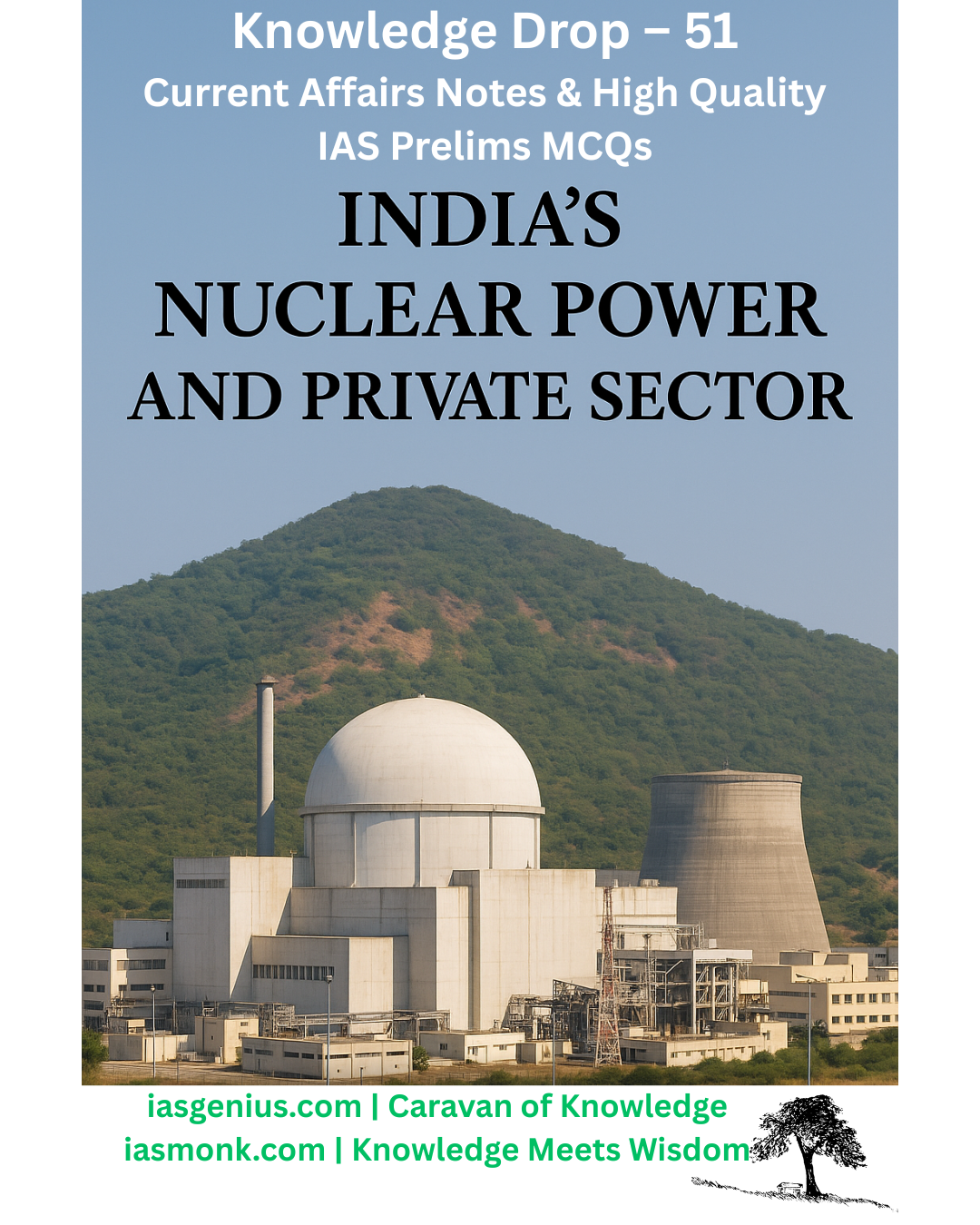
🌑Knowledge Drop – 51: “Opening the Atom: Can India Share Nuclear Power Without Losing Sovereignty?” | For Prelims: InDepth MCQs| For Mains, All G.S Papers: High Quality Essays
⚛️“Opening the Atom: Can India Share Nuclear Power Without Losing Sovereignty?”
📅 Date: 5 December 2025
📘 Syllabus: GS3 | Energy
🧭 Context
Prime Minister Narendra Modi has indicated that India is moving toward opening its nuclear power sector to private participation, marking a significant policy shift in one of the most tightly regulated strategic domains of the Indian state.
⚛️ What is Nuclear Energy?
Nuclear energy is released through nuclear reactions, primarily:
- Fission: Splitting of heavy nuclei like uranium or plutonium, releasing enormous energy used for electricity generation.
- Fusion: Combining lighter nuclei, still under experimental stages globally.
India currently relies on nuclear fission for power generation.
🏗️ Status of Nuclear Power in India
- Installed Capacity: 8,180 MW
- Reactors: 24 operational reactors
- Target: 100 GW by 2047 🇮🇳
- Under Construction:
- 10 reactors (8 GW) across Gujarat, Rajasthan, Tamil Nadu, Haryana, Karnataka & Madhya Pradesh
- Approval for 6×1208 MW nuclear plant in Andhra Pradesh with US collaboration
🔐 Existing Nuclear Framework
Until now, nuclear power plants have been:
- Owned & operated only by the State, mainly through:
- Nuclear Power Corporation of India Ltd (NPCIL)
- Bharatiya Nabhikiya Vidyut Nigam (BHAVINI)
📜 Proposed Legal Changes
To enable private participation, amendments are proposed to:
- Atomic Energy Act, 1962
Governs development, control & regulation of nuclear energy. - Civil Liability for Nuclear Damage Act, 2010
Fixes liability and compensation mechanisms in case of nuclear accidents.
🌱 Why Open the Nuclear Sector? (Benefits)
🔹 Faster Capacity Expansion
Private capital can bridge massive financing needs for large reactors.
🔹 Technological Advancement
Global expertise and innovation through collaboration.
🔹 Cost Efficiency
Competitive execution may reduce delays and cost overruns.
🔹 Energy Security
Supports India’s clean energy transition and reduces fossil fuel dependence.
⚠️ Key Concerns & Challenges
🚧 Regulatory Hurdles
Existing laws are restrictive and need careful amendment.
💰 High Capital Intensity
Long gestation periods deter private investment.
⚖️ Liability Risks
The Civil Liability Act places heavy responsibility on operators.
🛡️ Safety & Security
Nuclear power demands uncompromising regulatory oversight.
👥 Public Perception
Concerns over radiation, waste disposal, and accident risks.
🏛️ Government Initiatives Supporting the Shift
- ₹20,000 crore R&D mission for Small Modular Reactors (SMRs)
- Target to deploy 5 indigenous SMRs by 2033
- NPCIL–NTPC JV (ASHVINI) to build and operate nuclear plants
- Upcoming 4×700 MWe PHWR Mahi-Banswara project (Rajasthan)
🧩 Way Ahead
🔹 Clear Regulatory Framework ensuring safety, accountability & transparency
🔹 Public-Private Partnerships (PPPs) with strong state oversight
🔹 Gradual Rollout through pilot projects and SMRs before large-scale expansion
🌀 IAS Monk Whisper
Opening the nuclear sector is not about handing over the atom to markets,
but about disciplining capital to serve national energy security.
Target IAS-2026+: Highly Expected Prelims MCQs :
📌 Prelims Practice MCQs
Topic:
MCQ 1 | TYPE 1 — How Many Statements Are Correct?
Consider the following statements regarding nuclear power regulation in India:
1)Nuclear energy in India is governed primarily under the Atomic Energy Act, 1962
2)Private companies are currently allowed to own and operate nuclear reactors in India
3)NPCIL and BHAVINI are the only public sector entities operating nuclear power plants
4)Nuclear power falls under the Union List of the Seventh Schedule
How many of the above statements are correct?
A) Only two
B) Only three
C) All four
D) Only one
🌀 Didn’t get it? Click here (▸) for the Correct Answer & Explanation.
🟩 Correct Answer: B) Only three
🧠 Explanation:
1)✅ True – Atomic Energy Act, 1962 governs nuclear energy
2)❌ False – Private ownership and operation are not yet permitted
3)✅ True – NPCIL and BHAVINI operate all nuclear plants
4)✅ True – Atomic energy is a Union subject
MCQ 2 | TYPE 2 — Two-Statement Type
Consider the following statements:
1)The Civil Liability for Nuclear Damage Act, 2010 places liability primarily on nuclear plant operators
2)This liability structure has discouraged private sector participation in India’s nuclear sector
Which of the above statements is/are correct?
A) Only 1 is correct
B) Only 2 is correct
C) Both are correct
D) Neither is correct
🌀 Didn’t get it? Click here (▸) for the Correct Answer & Explanation.
🟩 Correct Answer: C) Both are correct
🧠 Explanation:
1)✅ True – Operator liability is explicitly mandated
2)✅ True – High liability risk deters private investment
MCQ 3 | TYPE 3 — Code-Based Statement Selection
With reference to India’s nuclear power expansion plans, consider the following statements:
1)India aims to increase nuclear power capacity to 100 GW by 2047
2)Small Modular Reactors (SMRs) are being promoted for faster deployment
3)India’s nuclear expansion is fully dependent on imported reactor technology
Which of the above statements are correct?
A) 1 and 2 only
B) 2 and 3 only
C) 1 and 3 only
D) 1, 2 and 3
🌀 Didn’t get it? Click here (▸) for the Correct Answer & Explanation.
🟩 Correct Answer: A) 1 and 2 only
🧠 Explanation:
1)✅ True – Government target for 2047
2)✅ True – SMRs are part of India’s strategy
3)❌ False – India has indigenous PHWR technology
MCQ 4 | TYPE 4 — Direct Factual Question
Which of the following public sector entities has been formed as a joint venture to develop nuclear power plants in India?
A) NPCIL–ONGC
B) NPCIL–NTPC (ASHVINI)
C) BHAVINI–BHEL
D) NTPC–BARC
🌀 Didn’t get it? Click here (▸) for the Correct Answer & Explanation.
🟩 Correct Answer: B) NPCIL–NTPC (ASHVINI)
🧠 Explanation:
ASHVINI is a joint venture of NPCIL and NTPC for building and operating nuclear power plants.
MCQ 5 | TYPE 5 — UPSC 2025 Linkage Reasoning Format (I, II, III)
Consider the following statements:
Statement I:
Opening India’s nuclear sector to private players requires major legal and regulatory reforms.
Statement II:
The Atomic Energy Act, 1962 restricts nuclear power generation to government entities.
Statement III:
The Civil Liability for Nuclear Damage Act imposes unlimited liability on equipment suppliers.
Which one of the following is correct?
A) Both Statements II and III are correct and both explain Statement I
B) Both Statements II and III are correct but only one explains Statement I
C) Only one of the Statements II and III is correct and that explains Statement I
D) Neither Statement II nor Statement III is correct
🌀 Didn’t get it? Click here (▸) for the Correct Answer & Explanation.
🟩 Correct Answer: C)
🧠 Explanation:
✅ Statement II is correct and explains why legal reform is required
❌ Statement III is incorrect – liability is primarily on operators, not unlimited supplier liability