




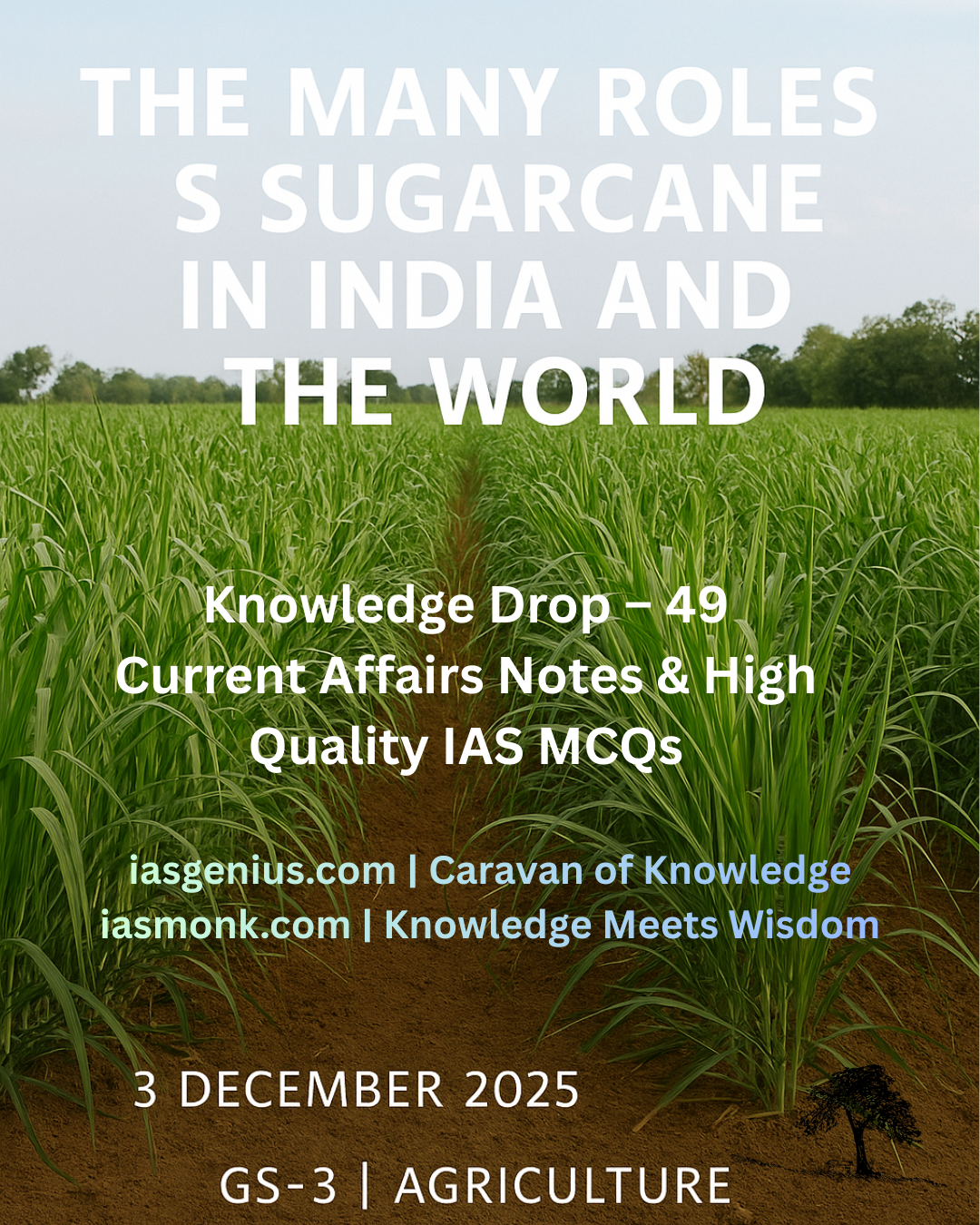
🌑Knowledge Drop – 49: Beyond Sweetness: Sugarcane’s Genetic, Economic & Ecological Story | For Prelims: InDepth MCQs| For Mains, All G.S Papers: High Quality Essays
🍬 Beyond Sweetness: Sugarcane’s Genetic, Economic & Ecological Story
KNOWLEDGE DROP – 49
3 December 2025
Syllabus: GS-3 | Agriculture 🌾 | Economy 💹 | Science & Technology 🧬
📌 Context
A recent global genomic study titled “The genomic footprints of wild Saccharum species trace domestication, diversification, and modern breeding of sugarcane” has analysed 390 sugarcane varieties across continents 🌍.
The findings reshape our understanding of sugarcane’s evolution, diversity, and future potential, with India—especially Arunachal Pradesh—emerging as a genetic hotspot.
🧬 What Makes Sugarcane Unique?
Sugarcane is not a simple crop. It is a polyploid giant.
- Polyploidy 🧠
Sugarcane possesses multiple sets of chromosomes, unlike most crops.
This genetic complexity arose due to human-mediated transport, hybridisation, and selective breeding across regions. - Genetic Mosaic 🧩
Modern sugarcane varieties are hybrids of several Saccharum species, carrying traits for:- High sucrose content 🍯
- Stress tolerance 🌡️
- Disease resistance 🦠
- India’s Genetic Treasure 🇮🇳
The study found maximum genetic diversity in Arunachal Pradesh, underscoring India’s role as a centre of origin and diversification.
🌾 Sugarcane in India: Scale & Spread
- Production (2024–25): ~4,400 lakh tonnes
- Major Belts:
- Sub-tropical North: UP, Bihar, Haryana, Punjab
- Tropical South: Maharashtra, Karnataka, Tamil Nadu, Andhra Pradesh
- Global Position:
- 🥇 Largest consumer
- 🥈 Second-largest producer of sugar globally
☀️ Ideal Growing Conditions
- Temperature: 20°C–35°C 🌤️
- Rainfall: 75–150 cm 🌧️
- Soil: Fertile, well-drained 🌱
- Harvesting prefers a cool, dry season ❄️
⚠️ Key Challenges
- 💧 Water Intensity:
Needs 1,500–2,500 mm water annually → groundwater stress - 📉 Yield Variations:
Caused by irrigation gaps, poor seed quality & soil fatigue - 🌦️ Climate Sensitivity:
Heatwaves, erratic monsoons reduce sucrose recovery - 🦠 Pests & Diseases:
Borers, red rot, pyrilla threaten productivity - 👷 Labour Shortages:
Harvesting remains labour-intensive - 💰 Delayed Payments:
FRP vs SAP mismatch stresses mills & farmers - 🛢️ Ethanol Diversion Dilemma:
Food vs fuel trade-offs emerging
🏛️ Government Interventions
- FRP (2025–26): ₹355/quintal at 10.25% recovery 💵
- PM-KUSUM: Solar pumps for irrigation ☀️
- ICAR Initiatives: Intercropping & varietal improvement 🌱
- ₹10,000 crore Cooperative Mill Package:
- Ethanol plants
- Cogeneration ⚡
- Modified Ethanol Interest Subvention:
6% interest support for 5 years - PMFBY: Insurance cover against climate & pest risks 🛡️
🔭 Way Ahead
India’s sugarcane future lies in:
- Precision breeding using genomics 🧬
- Water-efficient cultivation 💧
- Balanced sugar–ethanol policy ⚖️
- Soil health restoration & mechanisation 🚜
🎯 Target: Raise productivity from ~70 t/ha to 100–110 t/ha by 2030.
🧠 IAS Monk Whisper
“Sugarcane reminds us that abundance is not born of simplicity,
but of diversity carefully cultivated over time.”
Target IAS-2026+: Highly Expected Prelims MCQs :
📌 Prelims Practice MCQs
Topic: Beyond Sweetness: Sugarcane’s Genetic, Economic & Ecological Story
MCQ 1 | TYPE 1 — How Many Statements Are Correct?
Consider the following statements regarding sugarcane genetics and cultivation:
1)Sugarcane is a polyploid crop possessing more than two complete sets of chromosomes.
2)Polyploidy in sugarcane emerged naturally without any human intervention.
3)Arunachal Pradesh has been identified as a major centre of sugarcane genetic diversity.
4)Sugarcane is a self-pollinating crop with low genetic variability.
How many of the above statements are correct?
A) Only one
B) Only two
C) Only three
D) All four
🌀 Didn’t get it? Click here (▸) for the Correct Answer & Explanation.
🟩 Correct Answer: B) Only two
🧠 Explanation:
1)✅ True – Sugarcane is highly polyploid.
2)❌ False – Polyploidy expanded through human-mediated breeding and transport.
3)✅ True – Arunachal Pradesh shows highest diversity.
4)❌ False – Sugarcane is genetically complex, not uniform.
MCQ 2 | TYPE 2 — Two-Statement Type
Consider the following statements:
1)India is the world’s largest producer of sugarcane.
2)India is the world’s largest consumer of sugar.
Which of the above statements is/are correct?
A) Only 1 is correct
B) Only 2 is correct
C) Both are correct
D) Neither is correct
🌀 Didn’t get it? Click here (▸) for the Correct Answer & Explanation.
🟩 Correct Answer: B) Only 2 is correct
🧠 Explanation:
1)❌ False – India is the second-largest producer after Brazil.
2)✅ True – India is the largest consumer of sugar globally.
MCQ 3 | TYPE 3 — Code-Based Statement Selection
Consider the following statements regarding sugarcane cultivation in India:
1)Sugarcane requires high rainfall and abundant irrigation.
2)A cool and dry climate during ripening enhances sucrose recovery.
3)Sugarcane cultivation is equally suitable across all Indian agro-climatic zones.
Which of the above statements are correct?
A) 1 and 2 only
B) 2 and 3 only
C) 1 and 3 only
D) 1, 2 and 3
🌀 Didn’t get it? Click here (▸) for the Correct Answer & Explanation.
🟩 Correct Answer: A) 1 and 2 only
🧠 Explanation:
1)✅ True – It is a water-intensive crop.
2)✅ True – Dry, cool ripening boosts sugar content.
3)❌ False – Agro-climatic suitability varies sharply.
MCQ 4 | TYPE 4 — Direct Factual Question
Which of the following institutions declares the Fair and Remunerative Price (FRP) for sugarcane?
A) Ministry of Agriculture
B) NITI Aayog
C) Cabinet Committee on Economic Affairs
D) Commission for Agricultural Costs and Prices
🌀 Didn’t get it? Click here (▸) for the Correct Answer & Explanation.
🟩 Correct Answer: C) Cabinet Committee on Economic Affairs
🧠 Explanation:
The FRP is approved by the Cabinet Committee on Economic Affairs under the Sugarcane Control Order, 1966.
MCQ 5 | TYPE 5 — UPSC 2025 Linkage Reasoning Format (I, II, III)
Consider the following statements:
Statement I:
India is actively promoting ethanol production from sugarcane.
Statement II:
Sugarcane is a water-intensive crop with declining groundwater sustainability in major producing states.
Statement III:
Large-scale diversion of sugarcane to ethanol has raised concerns over food security and ecological stress.
Which one of the following is correct?
A) Both Statements II and III are correct and both explain Statement I
B) Both Statements II and III are correct but only one explains Statement I
C) Only one of the Statements II and III is correct and that explains Statement I
D) Neither Statement II nor Statement III is correct
🌀 Didn’t get it? Click here (▸) for the Correct Answer & Explanation.
🟩 Correct Answer: B) Both Statements II and III are correct but only one explains Statement I
🧠 Explanation:
✅ Statement II highlights ecological stress linked to sugarcane.
✅ Statement III explains the policy dilemma created by ethanol diversion.
👉 Only Statement III directly explains the policy debate in Statement I.