









🌑Knowledge Drop – 48: Durand Line: A Colonial Scar That Still Bleeds South Asia | For Prelims: InDepth MCQs| For Mains, All G.S Papers: High Quality Essays
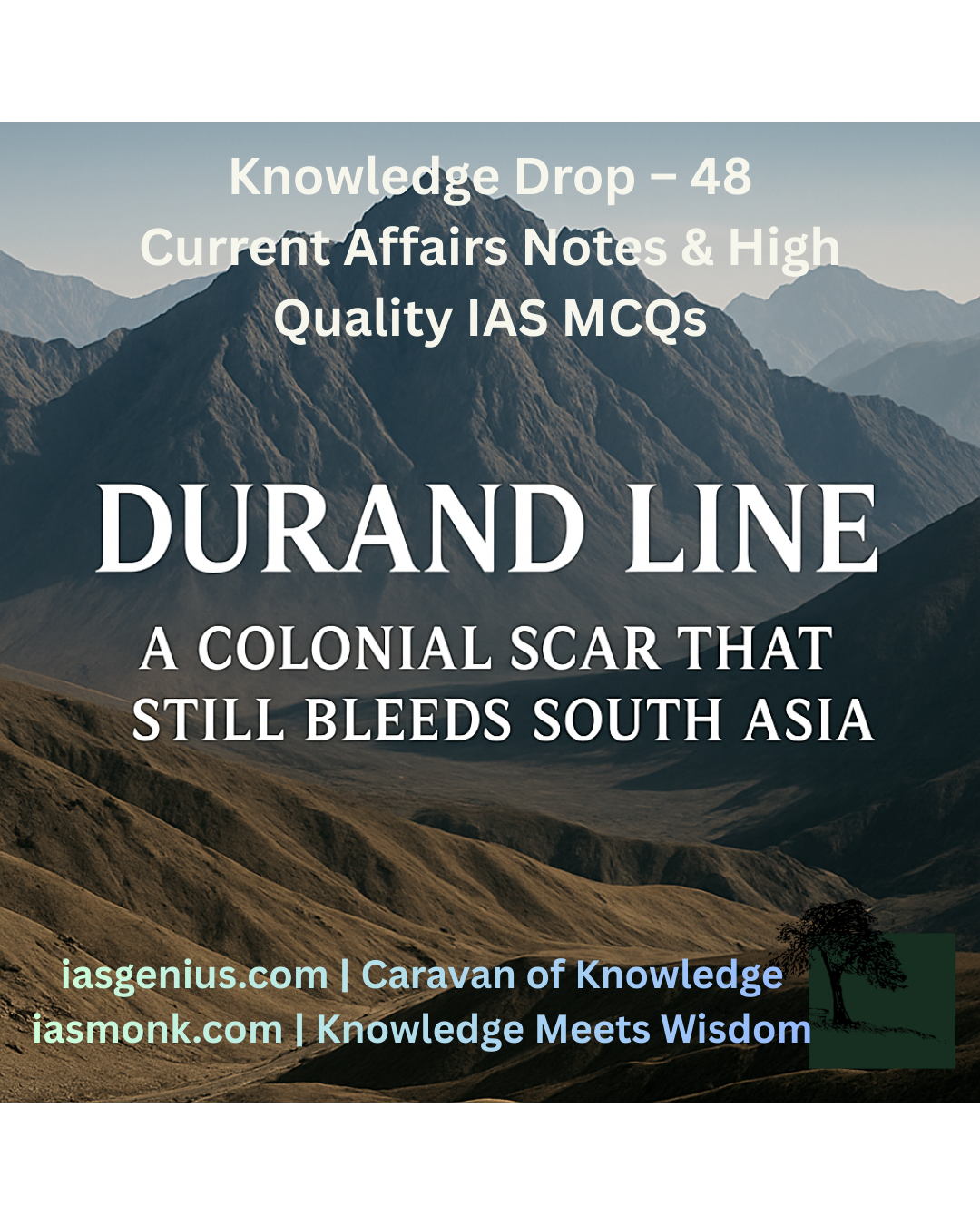
🌍 Knowledge Drop – 48
Durand Line: A Colonial Scar That Still Bleeds South Asia
📅 2 December 2025
🎯 Syllabus: GS2 – International Relations
🔎 Context
The recent collapse of peace talks between Pakistan and Afghanistan has once again pushed the Durand Line into the spotlight. More than a disputed boundary, it remains a living symbol of how colonial-era decisions continue to shape modern geopolitics in South Asia.
🕰️ Historical Background of the Durand Line
🗺️ The Durand Line is a roughly 2,640-kilometre frontier, stretching from the Iran border in the west to the China border in the east, cutting across the Hindu Kush, Karakoram ranges, and arid deserts.
✍️ It was drawn in 1893 through an agreement between Sir Henry Mortimer Durand, Foreign Secretary of British India, and Emir Abdur Rahman Khan of Afghanistan.
⚠️ The agreement:
- Split Pashtun tribal homelands
- Fragmented ethnic and social cohesion
- Consolidated British control over Balochistan
🧠 What was administratively convenient for colonial rulers became a structural fault line for the region.
🏴 Post-Partition Developments
🇵🇰 After Independence, Pakistan inherited the Durand Line as its western international boundary.
🇦🇫 Afghanistan, however, rejected its legitimacy, arguing that:
- It was imposed under colonial coercion
- It lacked popular Afghan consent
- It was limited in duration
🔥 The Pashtunistan movement, demanding a separate homeland, further strained relations.
🕌 Importantly, successive Afghan governments — including the Taliban — have refused to recognise the Durand Line, keeping the dispute alive.
🚨 Recent Tensions Between Pakistan and Afghanistan
🚧 In 2017, Pakistan began fencing the Durand Line to curb militancy, illegal crossings, and insurgent movement.
❌ Afghanistan views this fencing as unilateral and illegitimate, leading to repeated clashes.
🕊️ Recent peace talks mediated by Turkey and Qatar collapsed, followed by:
- 🔫 Cross-border firing
- ⚔️ Retaliatory military actions
- 📉 Diplomatic deterioration
This underlines how fragile and combustible the frontier remains.
🌏 Regional Impact of the Dispute
📦 Economic Strain on Afghanistan
Afghanistan’s dependence on transit trade through Pakistan means border closures cripple commerce, humanitarian aid, and livelihoods.
🧭 Erosion of Pakistan’s Regional Ambitions
Instability undermines Pakistan’s vision of becoming a trade corridor linking South Asia with Central Asia.
🇮🇳 Strategic Space for India
Afghanistan may deepen ties with India via:
- ⚓ Chabahar Port
- 🚆 International North–South Transport Corridor (INSTC)
bypassing Pakistan altogether.
👥 Human Cost
Border villages and families straddling the frontier face repeated disruption, deepening humanitarian stress.
🔐 Security Spillovers
Instability fuels arms trafficking, drug trade, and terror financing. Groups like LeT and JeM have historically exploited Afghan–Pak instability, posing risks for India.
🛣️ Way Ahead
🗣️ Pakistan and Afghanistan must institutionalise regular border-management and security dialogue.
🚪 Reopening crossings under mutually agreed protocols can stabilise trade and humanitarian flows.
🤝 Confidence-building measures involving tribal elders and civil society are essential to manage local tensions.
🧾 Conclusion
The turbulence along the Durand Line reflects deeper structural problems — colonial cartography, ethnic fragmentation, coercive diplomacy, and chronic insecurity.
🧭 Until these are addressed through sustained diplomacy and cooperative security mechanisms, the Durand Line will remain not just a border, but a bleeding scar on South Asia’s geopolitical map.
Target IAS-2026+: Highly Expected Prelims MCQs :
📌 Prelims Practice MCQs
Topic: Durand Line: A Colonial Scar That Still Bleeds South Asia
MCQ 1 | TYPE 1 — How Many Statements Are Correct?
Consider the following statements regarding the Durand Line:
1)The Durand Line was drawn in 1893 between British India and Afghanistan.
2)It divided Pashtun tribal areas across present-day Pakistan and Afghanistan.
3)Afghanistan has consistently recognised the Durand Line as an international border.
4)Pakistan inherited the Durand Line as its western boundary after 1947.
How many of the above statements are correct?
A) Only two
B) Only three
C) All four
D) Only one
🌀 Didn’t get it? Click here (▸) for the Correct Answer & Explanation.
🟩 Correct Answer: B) Only three
🧠 Explanation:
1)✅ True – Agreement signed in 1893 by Durand and Abdur Rahman Khan.
2)✅ True – Pashtun homelands were split by the line.
3)❌ False – Afghanistan has never formally recognised it.
4)✅ True – Pakistan inherited it post-Partition.
MCQ 2 | TYPE 2 — Two-Statement Type
Consider the following statements:
1)Pakistan began fencing the Durand Line in 2017 primarily to curb insurgency and illegal crossings.
2)Afghanistan views Pakistan’s fencing of the Durand Line as a legitimate and mutually agreed measure.
Which of the above statements is/are correct?
A) Only 1 is correct
B) Only 2 is correct
C) Both are correct
D) Neither is correct
🌀 Didn’t get it? Click here (▸) for the Correct Answer & Explanation.
🟩 Correct Answer: A) Only 1 is correct
🧠 Explanation:
1)✅ True – Security concerns drove the fencing initiative.
2)❌ False – Afghanistan considers the fencing unilateral and illegitimate.
MCQ 3 | TYPE 3 — Code-Based Statement Selection
With reference to the implications of instability along the Durand Line, consider the following statements:
1)Border tensions adversely affect Afghanistan’s transit-dependent economy.
2)Persistent instability undermines Pakistan’s ambition to act as a regional trade corridor.
3)The Durand Line dispute has no relevance for India’s security interests.
Which of the above statements are correct?
A) 1 and 2 only
B) 2 and 3 only
C) 1 and 3 only
D) 1, 2 and 3
🌀 Didn’t get it? Click here (▸) for the Correct Answer & Explanation.
🟩 Correct Answer: A) 1 and 2 only
🧠 Explanation:
1)✅ True – Trade and aid flows suffer due to border closures.
2)✅ True – Regional connectivity depends on stability.
3)❌ False – Terror spillovers affect India directly.
MCQ 4 | TYPE 4 — Direct Factual Question
Who were the signatories to the agreement that created the Durand Line?
A) Lord Curzon and Amir Habibullah Khan
B) Sir Henry Mortimer Durand and Emir Abdur Rahman Khan
C) Lord Mountbatten and King Amanullah Khan
D) Sir Stafford Cripps and Mohammad Zahir Shah
🌀 Didn’t get it? Click here (▸) for the Correct Answer & Explanation.
🟩 Correct Answer: B) Sir Henry Mortimer Durand and Emir Abdur Rahman Khan
🧠 Explanation:
The 1893 agreement was signed between the British Indian Foreign Secretary and the Afghan Emir.
MCQ 5 | TYPE 5 — UPSC 2025 Linkage Reasoning Format (I, II, III)
Consider the following statements:
Statement I:
The Durand Line continues to be a persistent source of instability in South Asia.
Statement II:
Afghanistan has never formally accepted the Durand Line as an international border.
Statement III:
The Durand Line fragmented ethnically homogenous Pashtun tribal regions during colonial rule.
Which one of the following is correct?
A) Both Statements II and III are correct and both explain Statement I
B) Both Statements II and III are correct but only one explains Statement I
C) Only one of the Statements II and III is correct and that explains Statement I
D) Neither Statement II nor Statement III is correct
🌀 Didn’t get it? Click here (▸) for the Correct Answer & Explanation.
🟩 Correct Answer: A)
🧠 Explanation:
✅ Non-recognition sustains diplomatic and security tensions.
✅ Ethnic fragmentation fuels long-term instability.
Together, they explain why the Durand Line remains volatile.