









🌑Knowledge Drop – 41: Supreme Court Accepts New Definition of Aravalli Hills to Restrict Mining | For Prelims: InDepth MCQs| For Mains, All G.S Papers: High Quality Essays
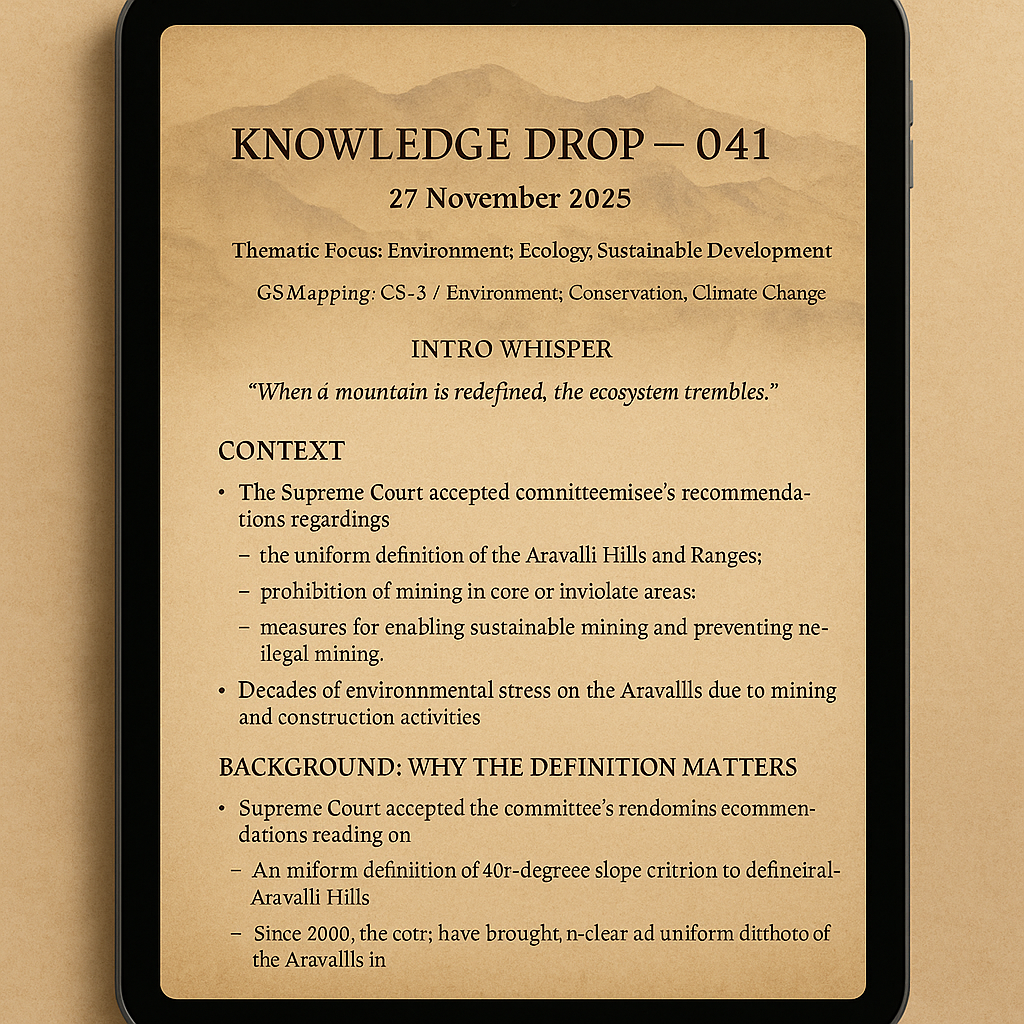
🌿 Knowledge Drop – 041
Supreme Court Accepts New Definition of Aravalli Hills to Restrict Mining
27 November 2025
Thematic Focus: Environment, Ecology, Sustainable Development
GS Mapping: GS-3 / Environment, Conservation, Climate Change
🌱 Intro Whisper
“When a mountain is redefined, the ecosystem trembles.”
In a significant environmental intervention, the Supreme Court of India has accepted the recommendations of a Union Environment Ministry–appointed panel on redefining the Aravalli Hills and Ranges. The decision aims to curb rampant mining and ecological degradation but has simultaneously triggered concerns about the future protection of one of India’s oldest mountain systems. 🌄
🌍 CONTEXT
- The Supreme Court accepted the committee’s recommendations on:
- A uniform definition of the Aravalli Hills and Ranges
- Prohibition of mining in core or inviolate areas
- Measures to enable sustainable mining and prevent illegal mining
- The ruling follows decades of environmental stress on the Aravallis due to mining, construction, and unregulated development. ⛏️
- Earlier, the Court had asked the government to evolve a clear and uniform definition of the Aravalli Hills to resolve regulatory ambiguities.
🧭 BACKGROUND: WHY THE DEFINITION MATTERS
- For years, different agencies used different criteria to identify the Aravalli Hills.
- Since 2010, the Forest Survey of India (FSI) used a 3-degree slope criterion.
- In 2024, a technical committee revised the benchmark to:
- Minimum 4.57-degree slope
- Minimum 30-metre height
- This approach would have brought nearly 40% of the Aravallis under protection.
📐 NEW DEFINITION ACCEPTED BY THE SC
The panel’s revised definition states:
- Any landform at an elevation of 100 metres or more above the local relief, along with its slopes and adjacent land, will be considered part of the Aravalli Hills.
📊 Impact of the New Definition (as per FSI assessment):
- Only 1,048 sq km (about 8.7%) of the Aravalli landscape across 15 districts in Rajasthan meets the 100-metre criterion.
- This implies that nearly 90% of the Aravalli region may fall outside the legally protected definition.
🏔️ THE ARAVALLI RANGE: AN ECOLOGICAL SHIELD
- One of the oldest mountain ranges in the world, stretching about 692 km.
- Passes through Gujarat, Rajasthan, Haryana, and extends into Delhi.
- Rajasthan accounts for nearly two-thirds of the range.
🌬️ Ecological Importance
- Acts as a natural barrier against desertification from the Thar Desert.
- Helps regulate regional climate and air quality, especially in the NCR.
- Serves as a watershed for rivers like the Sabarmati, Luni, and Banas.
- Supports dry deciduous forests, scrublands, grasslands, and diverse wildlife. 🐾
⚠️ CONCERNS WITH THE NEW DEFINITION
- Exclusion Risk: More than 90% of the Aravallis may be excluded from legal protection.
- Mining & Construction Threat: Areas excluded could be opened up to mining and real estate.
- Air Quality Impact: Reduced ecological buffering could worsen air pollution in the NCR. 🌫️
- District-Level Gaps: Several districts traditionally associated with the Aravallis were left out of the ministry’s list of 34 districts.
🛠️ WAY AHEAD: SC’S DIRECTIONS
- While accepting the 100-metre height criterion, the Supreme Court has:
- Directed the Environment Ministry to prepare a Management Plan for Sustainable Mining.
- Asked that the plan be developed with assistance from the Indian Council of Forestry Research and Education (ICFRE).
- The objective is to balance ecological preservation with regulated resource use. ♻️
🌿 Closing Note
The Aravalli debate underscores a deeper dilemma in environmental governance: Should protection depend on technical definitions alone, or on ecological function and long-term impact?
How India answers this question will shape not just the future of the Aravallis, but the credibility of its environmental jurisprudence.
Target IAS-26: Daily MCQs :
📌 Prelims Practice MCQs
Topic: SET-1
MCQ 1 TYPE 1 — How Many Statements Are Correct?
Consider the following statements regarding the Supreme Court’s decision on the Aravalli Hills:
1)The Supreme Court accepted a Union Environment Ministry panel’s recommendations to evolve a uniform definition of the Aravalli Hills.
2)The new definition prohibits all forms of mining across the entire Aravalli range.
3)The Court directed measures to prevent illegal mining and promote sustainable mining practices.
4)The case arose due to decades of environmental degradation caused by mining and construction activities.
How many of the above statements are correct?
A) Only two
B) Only three
C) All four
D) Only one
🌀 Didn’t get it? Click here (▸) for the Correct Answer & Explanation.
🟩 Correct Answer: B) Only three
🧠 Explanation:
1)✅ True – SC accepted the panel’s recommendations on definition.
2)❌ False – Mining is prohibited only in core/inviolate areas, not entirely.
3)✅ True – Sustainable mining and curbing illegal mining were directed.
4)✅ True – Long-standing mining pressure triggered judicial intervention.
MCQ 2 TYPE 2 — Two-Statement Type
Consider the following statements:
1)The Forest Survey of India has been using a 3-degree slope criterion to define the Aravalli Hills since 2010.
2)The 2024 technical committee reduced the slope benchmark to bring more areas under protection.
Which of the above statements is/are correct?
A) Only 1 is correct
B) Only 2 is correct
C) Both are correct
D) Neither is correct
🌀 Didn’t get it? Click here (▸) for the Correct Answer & Explanation.
🟩 Correct Answer: A) Only 1 is correct
🧠 Explanation:
1)✅ True – FSI used a 3-degree slope benchmark.
2)❌ False – The committee increased the benchmark (4.57 degrees), not reduced it.
MCQ 3 TYPE 3 — Code-Based Statement Selection
With reference to the new definition of the Aravalli Hills accepted by the Supreme Court, consider the following statements:
1)Any landform with an elevation of 100 m or more above local relief will be considered part of the Aravalli Hills.
2)Under this definition, nearly 90% of the Aravalli landscape may fall outside the protected category.
3)The definition is expected to expand forest cover across all Aravalli districts.
Which of the above statements are correct?
A) 1 and 2 only
B) 2 and 3 only
C) 1 and 3 only
D) 1, 2 and 3
🌀 Didn’t get it? Click here (▸) for the Correct Answer & Explanation.
🟩 Correct Answer: A) 1 and 2 only
🧠 Explanation:
1)✅ True – 100 m elevation is the new criterion.
2)✅ True – Around 90% may be excluded.
3)❌ False – The definition may reduce protected areas, not expand them.
MCQ 4 TYPE 4 — Direct Factual Question
Which of the following rivers is not associated with the Aravalli Range as a watershed region?
A) Luni
B) Sabarmati
C) Banas
D) Godavari
🌀 Didn’t get it? Click here (▸) for the Correct Answer & Explanation.
🟩 Correct Answer: D) Godavari
🧠 Explanation:
The Aravallis act as a watershed for rivers like Luni, Sabarmati, and Banas, but not the Godavari.
MCQ 5 TYPE 5 — UPSC 2025 Linkage Reasoning Format (I, II, III)
Consider the following statements:
Statement I:
The Supreme Court asked the Environment Ministry to prepare a Management Plan for Sustainable Mining in the Aravalli Hills.
Statement II:
The Indian Council of Forestry Research and Education (ICFRE) is expected to assist in framing this management plan.
Which one of the following is correct?
A) Both Statement I and Statement II are correct and Statement II explains Statement I
B) Both Statement I and Statement II are correct but Statement II does not explain Statement I
C) Statement I is correct but Statement II is incorrect
D) Statement I is incorrect but Statement II is correct
🌀 Didn’t get it? Click here (▸) for the Correct Answer & Explanation.
🟩 Correct Answer: A)
🧠 Explanation:
✅ ICFRE’s technical expertise is crucial for designing a sustainable mining framework under the SC’s directions.