






🌑Knowledge Drop – 40: Arunachal Pradesh Is an Integral and Inalienable Part of India: MEA | For Prelims: InDepth MCQs| For Mains, All G.S Papers: High Quality Essays
🏔️ Knowledge Drop – 40
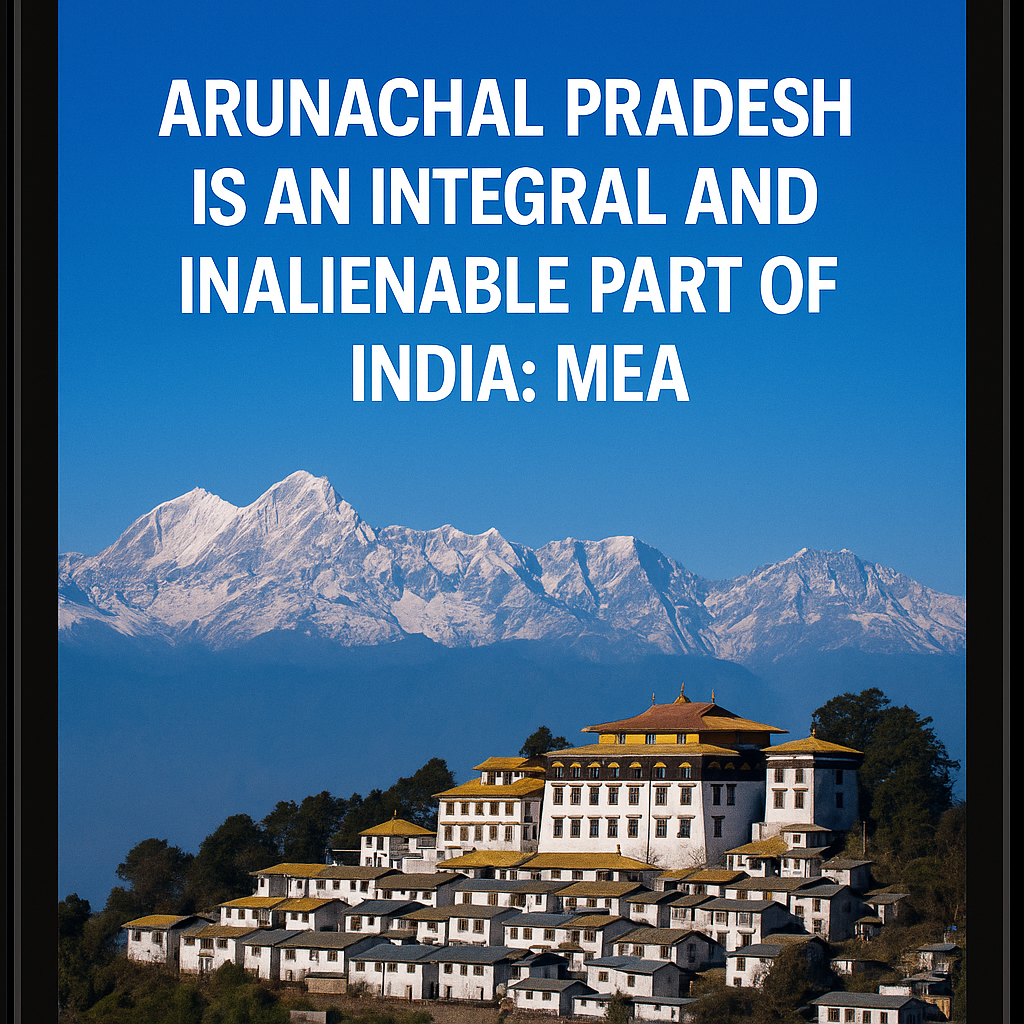
Arunachal Pradesh Is an Integral and Inalienable Part of India: MEA
Post: 27 November 2025
Thematic Focus: International Relations, Internal Security, Border Disputes
GS Mapping: GS-2 / India–China Relations, GS-3 / Internal Security
🔔 Intro Whisper
“Borders may be disputed on maps, but sovereignty is settled by people, law, and history.”
A routine airport check turned into a diplomatic flashpoint when a Chinese immigration authority questioned the validity of an Indian passport simply because the holder’s birthplace was Arunachal Pradesh. India’s response was unequivocal: Arunachal Pradesh is an integral and inalienable part of India. 🧭
🌏 CONTEXT
- Chinese immigration officials at Shanghai airport detained an Indian citizen for nearly 18 hours, claiming her passport was “invalid” as her birthplace was Arunachal Pradesh.
- The officials asserted that Arunachal Pradesh is not part of India.
- The Ministry of External Affairs (MEA) strongly criticised China, terming the detention arbitrary and a violation of international civil aviation norms, including the Chicago and Montreal Conventions. ✈️
- India reiterated its consistent stand on sovereignty over Arunachal Pradesh.
🗺️ ARUNACHAL PRADESH: GEOGRAPHICAL & HISTORICAL CONTEXT
- Formerly known as the North Eastern Frontier Agency (NEFA) until 1972.
- Largest State in India’s northeast.
- Shares borders with:
- China (Tibet) to the north and northeast
- Bhutan to the west
- Myanmar to the east
Its strategic location makes it a key region in India’s eastern security architecture. 🛡️
🐉 CHINA’S CLAIM OVER ARUNACHAL PRADESH
📌 Nature of the Claim
- China claims Arunachal Pradesh as part of “Southern Tibet”.
- Primary focus is on the Tawang district, bordering Bhutan and Tibet.
❓ WHY DOES CHINA CLAIM ARUNACHAL PRADESH?
🕍 1. Tawang Monastery
- Second-largest monastery of Tibetan Buddhism globally.
- Founded in 1680–81 by Merag Lodroe Gyamtso to honour the wishes of the Fifth Dalai Lama.
- China argues this religious linkage implies historical Tibetan control.
🧬 2. Cultural & Ethnic Connections
- Certain tribes in upper Arunachal share cultural ties with Tibet.
- China fears these links could fuel pro-democracy or pro-Tibetan movements within Tibet.
📜 3. Dispute Over the McMahon Line
- Drawn during the 1914 Simla Convention between British India and Tibet.
- Clearly placed Arunachal Pradesh within Indian territory.
- China rejects the Convention, arguing Tibet lacked sovereign authority to sign it.
📜 SIMLA CONVENTION, 1914
- Included Chinese and Tibetan representatives.
- Gave birth to the McMahon Line in the eastern sector.
- Clearly demarcated the boundary between India and Tibet.
- India recognises it as a valid international boundary; China does not.
🧘 ESCAPE OF THE DALAI LAMA (1959)
- The Dalai Lama fled Tibet amid Chinese crackdown.
- Entered India through Tawang and stayed at the Tawang Monastery.
- This episode remains a sensitive issue in India–China relations.
🎯 STRATEGIC IMPORTANCE OF ARUNACHAL PRADESH
- Overlooks the Tibetan Plateau.
- Proximity to key Chinese military assets in Tibet.
- Control over the region would strengthen China’s buffer and military posture in the eastern sector.
🇧🇹 The Bhutan Factor
- If China gains control of Arunachal, Bhutan would be flanked by China on both west and east.
- This would significantly alter the regional balance.
♟️ Bargaining Tool in Border Talks
- China uses Arunachal claims to seek concessions in other sectors, especially Aksai Chin, which it controls.
🇮🇳 INDIA’S STAND (CLEAR & CONSISTENT)
🧭 Arunachal Pradesh Is an Integral Part of India
- Historical, legal, and administrative continuity.
- Democratically elected governments under the Indian Constitution.
📏 McMahon Line Is the Legal Boundary
- Recognised by India as legitimate and binding.
❌ China’s Claims Are Unfounded
- Stapled visas, renaming places, or passport objections do not change ground reality.
🏛️ Evidence of Effective Control
- Continuous governance since Independence.
- Elections, judiciary, welfare schemes, and armed forces presence.
- Strong cultural and political identification of local people with India.
🏗️ Development Will Continue
- India rejects Chinese objections to infrastructure projects.
- Development of Indian territory is an internal matter.
🔮 WAY AHEAD
- India has initiated a 11,000 MW hydroelectric project in Upper Subansiri, Arunachal Pradesh.
- Seen as both:
- A development initiative
- A strategic response to Chinese dam construction and possible flow diversion upstream. 💧
- India continues to assert that its sovereignty over Arunachal Pradesh is internationally recognised and non-negotiable.
🪶 Closing Note
Arunachal Pradesh is not a matter of perception or propaganda. It is a lived reality of governance, identity, and constitutional integration.
Sovereignty is not defined by claims — it is defined by control, consent, and continuity.
Target IAS-26: Daily MCQs :
📌 Prelims Practice MCQs
Topic: Arunachal Pradesh Is an Integral and Inalienable Part of India: MEASET-1
MCQ 1 TYPE 1 — How Many Statements Are Correct?
Consider the following statements regarding Arunachal Pradesh and recent India–China tensions:
1)Arunachal Pradesh was known as the North Eastern Frontier Agency (NEFA) until 1972.
2)China officially recognises the McMahon Line as the legal boundary in the eastern sector.
3)The Ministry of External Affairs termed the detention of an Indian citizen at Shanghai airport as a violation of international civil aviation norms.
4)Arunachal Pradesh shares an international boundary with Bhutan and Myanmar.
How many of the above statements are correct?
A) Only two
B) Only three
C) All four
D) Only one
🌀 Didn’t get it? Click here (▸) for the Correct Answer & Explanation.
🟩 Correct Answer: B) Only three
🧠 Explanation:
1)✅ True – Arunachal was NEFA until it became a State in 1972.
2)❌ False – China rejects the McMahon Line.
3)✅ True – MEA cited violations of the Chicago and Montreal Conventions.
4)✅ True – Arunachal borders Bhutan and Myanmar.
MCQ 2 TYPE 2 — Two-Statement Type
Consider the following statements:
1)China claims Arunachal Pradesh as part of “Southern Tibet”.
2)Tawang Monastery was founded in the 19th century during British rule in India.
Which of the above statements is/are correct?
A) Only 1 is correct
B) Only 2 is correct
C) Both are correct
D) Neither is correct
🌀 Didn’t get it? Click here (▸) for the Correct Answer & Explanation.
🟩 Correct Answer: A) Only 1 is correct
🧠 Explanation:
1)✅ True – China refers to Arunachal as Southern Tibet.
2)❌ False – Tawang Monastery was founded in 1680–81.
MCQ 3 TYPE 3 — Code-Based Statement Selection
With reference to the McMahon Line and the Simla Convention (1914), consider the following statements:
1)The Simla Convention involved representatives of British India, Tibet, and China.
2)The McMahon Line demarcated the boundary between India and Tibet in the eastern sector.
3)China accepts the Simla Convention as legally binding.
Which of the above statements are correct?
A) 1 and 2 only
B) 2 and 3 only
C) 1 and 3 only
D) 1, 2 and 3
🌀 Didn’t get it? Click here (▸) for the Correct Answer & Explanation.
🟩 Correct Answer: A) 1 and 2 only
🧠 Explanation:
1)✅ True – All three parties participated in the Convention.
2)✅ True – The McMahon Line emerged from the Convention.
3)❌ False – China rejects the Convention and the Line.
MCQ 4 TYPE 4 — Direct Factual Question
MCQ 4 | TYPE 4 — Direct Factual Question
Which international conventions were cited by India while criticising China for the arbitrary detention of an Indian citizen at Shanghai airport?
A) Vienna and Hague Conventions
B) Chicago and Montreal Conventions
C) Geneva and Tokyo Conventions
D) New York and Rome Conventions
🌀 Didn’t get it? Click here (▸) for the Correct Answer & Explanation.
🟩 Correct Answer: B) Chicago and Montreal Conventions
🧠 Explanation:
These conventions govern international civil aviation norms and passenger rights.
MCQ 5 TYPE 5 — UPSC 2025 Linkage Reasoning Format (I, II, III)
Consider the following statements:
Statement I:
India considers Arunachal Pradesh an integral and inalienable part of its territory.
Statement II:
India has exercised continuous administrative, political, and military control over Arunachal Pradesh since Independence.
Which one of the following is correct?
A) Both Statement I and Statement II are correct and Statement II explains Statement I
B) Both Statement I and Statement II are correct but Statement II does not explain Statement I
C) Statement I is correct but Statement II is incorrect
D) Statement I is incorrect but Statement II is correct
🌀 Didn’t get it? Click here (▸) for the Correct Answer & Explanation.
🟩 Correct Answer: A)
🧠 Explanation:
✅ Effective control and democratic integration form the basis of India’s sovereignty claim.