





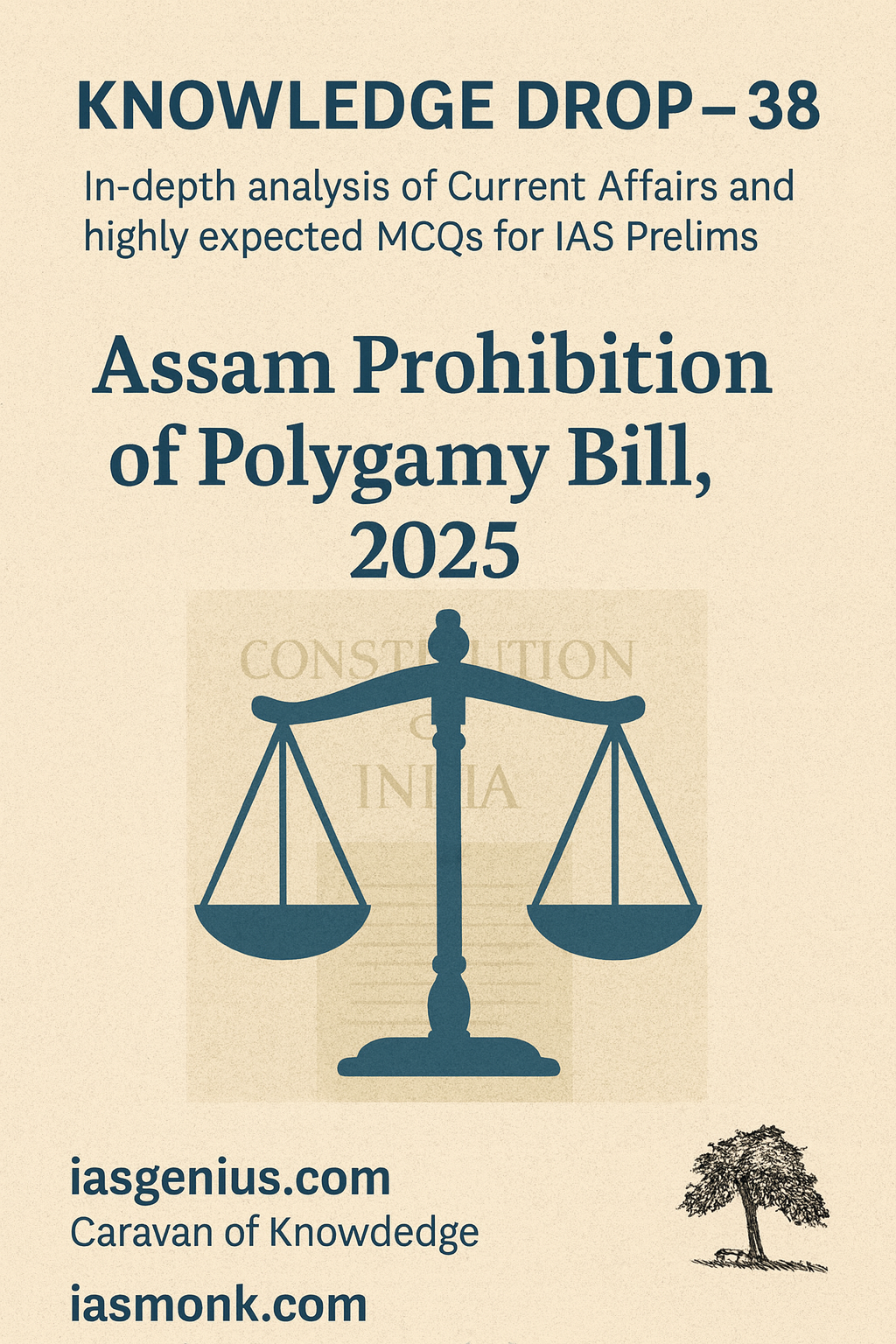
🌑Knowledge Drop – 038: Assam Prohibition of Polygamy Bill, 2025 | For Prelims: InDepth MCQs| For Mains, All G.S Papers: High Quality Essays
🌑 Knowledge Drop – 038
⚖️ Assam Prohibition of Polygamy Bill, 2025
Highlights Today — November PETAL 038
26 November 2025
Thematic Focus: Society, Gender Justice, Constitutional Values
GS Mapping: GS-1 / Indian Society, GS-2 / Polity (State Legislations, Fundamental Rights)
🧭 Intro Whisper — “When law steps into tradition, society begins to renegotiate itself.”
Customs carry memory.
Laws carry intention.
And when the two collide, societies are forced to pause, reflect, and reform.
The Assam Prohibition of Polygamy Bill, 2025 represents one such moment — where social practice, constitutional morality, and state authority intersect in the pursuit of justice.
🔍 KEY HIGHLIGHTS
• 🏛️ Assam government introduced the Assam Prohibition of Polygamy Bill, 2025 to criminalise polygamy.
• ⚠️ The Bill prescribes stringent criminal penalties, including imprisonment and fines.
• 📜 Constitutional and customary exemptions have been retained.
• 🌐 The law has extra-territorial applicability, extending beyond Assam’s borders.
• 🛡️ The Bill foregrounds gender justice, protection, and victim compensation.
📜 THE KNOWLEDGE CORE
⚖️ 1. What Does the Assam Prohibition of Polygamy Bill, 2025 Seek to Do?
The Bill seeks to criminalise polygamy within Assam, treating it as a social offence rather than a private personal matter.
Its objectives are twofold:
• to deter the practice through criminal sanctions, and
• to protect women affected by polygamous marriages through institutional safeguards.
🗺️ 2. Jurisdiction and Applicability: Who Comes Under the Law?
The Bill applies across Assam with constitutionally grounded exclusions.
It does not apply to:
• 🏔️ Areas under the Sixth Schedule — Bodoland Territorial Region, Dima Hasao, Karbi Anglong and West Karbi Anglong
• 👥 Scheduled Tribes under Article 342, governed by customary laws permitting multiple marriages
At the same time, the Bill extends its reach to include:
• 🌐 Residents of Assam entering polygamous marriages outside the State
• 🧾 Non-residents who own property in Assam or avail State-funded schemes or subsidies
This combination of territorial exemption and extra-territorial reach gives the Bill distinct legal significance.
🚨 3. Punishments and Deterrence Framework
The Bill prescribes a graded punishment structure:
• ⛓️ Up to 7 years imprisonment and fine for engaging in polygamy
• ⛓️ Up to 10 years imprisonment for concealing an existing marriage before entering another
• 🔁 Double punishment for repeat offenders
This signals the State’s intent to treat polygamy as a serious criminal offence, not a mere civil irregularity.
👩⚖️ 4. Liability of Clerics and Abettors
The Bill expands accountability beyond individual offenders.
It brings under its ambit:
• 🛐 Religious officials or clerics who knowingly solemnise polygamous marriages
• 🏘️ Village heads, Qazis, parents or guardians who assist or conceal such marriages
They may face:
• ⛓️ Imprisonment up to 2 years
• 💰 Fines up to ₹1 lakh
Clerics may face penalties up to ₹1.5 lakh, along with imprisonment.
This provision seeks to dismantle the social ecosystem that enables polygamy.
🛡️ 5. Safeguards, Exemptions and Victim Support
• ⏳ The Bill is non-retroactive — earlier marriages remain valid
• 🚓 Police officers are empowered to intervene proactively to prevent prohibited marriages
• 🤝 A designated authority is proposed to process compensation claims for affected women
This marks a shift from punishment alone towards protective and restorative justice.
📚 6. Polygamy in India: The Broader Legal Context
India follows a plural personal law system:
• 📜 Hindu Marriage Act, 1955 — mandates monogamy
• 📜 Special Marriage Act, 1954 — enforces monogamy in civil marriages
• 🕌 Muslim Personal Law (Shariat) — permits up to four wives, subject to conditions
• ✝️ Christian and Parsi laws — prohibit polygamy
• 🌾 Certain tribal customary laws — continue to recognise polygamy
The Assam Bill emerges within this complex legal mosaic, where diversity and equality often pull in opposite directions.
🧠 7. Why This Bill Matters for Society and Governance
• ⚖️ Reopens the debate on personal law vs constitutional morality
• 🛡️ Reinforces gender justice and dignity of women
• 🧭 Highlights the role of States as laboratories of social reform
• 📢 Revives discussions on Uniform Civil Code vs incremental reform
🌿 A Thought Spark — by IAS Monk
“When law questions custom, society does not lose its roots —
it gains the courage to choose justice over habit.”
Target IAS-26: Daily MCQs :
📌 Prelims Practice MCQs
Topic: Assam Prohibition of Polygamy Bill, 2025
MCQ 1 TYPE 1 — How Many Statements Are Correct?
Consider the following statements regarding the Assam Prohibition of Polygamy Bill, 2025:
1)The Bill applies uniformly across all areas of Assam without any constitutional exemptions.
2)The Bill has extra-territorial applicability covering certain actions outside Assam.
3)The Bill prescribes higher punishment for concealing an existing marriage.
4)The Bill applies retroactively to marriages conducted before its enforcement.
How many of the above statements are correct?
A) Only one
B) Only two
C) Only three
D) All four
🌀 Didn’t get it? Click here (▸) for the Correct Answer & Explanation.
🟩 Correct Answer: B) Only Only two
🧠 Explanation:
1)❌ False – Sixth Schedule areas and certain tribal communities are exempt.
2)✅ True – Extra-territorial applicability is explicitly provided.
3)✅ True – Concealment attracts higher punishment.
4)❌ False – The Bill is non-retroactive.
MCQ 2 TYPE 2 — Two-Statement Type
Consider the following statements:
1)Under the Assam Prohibition of Polygamy Bill, religious officials who solemnise polygamous marriages may be penalised.
2)The Bill excludes Scheduled Tribes under Article 342 due to protection of customary laws.
Which of the above statements is/are correct?
A) Only 1 is correct
B) Only 2 is correct
C) Both are correct
D) Neither is correct
🌀 Didn’t get it? Click here (▸) for the Correct Answer & Explanation.
🟩 Correct Answer: C) Both are correct
🧠 Explanation:
1)✅ True – Clerics and abettors are explicitly covered.
2)✅ True – Article 342 tribes governed by customary laws are exempt.
MCQ 3 TYPE 3 — Code-Based Statement Selection
With reference to the legal framework on polygamy in India, consider the following statements:
1)Monogamy is mandated under the Hindu Marriage Act, 1955.
2)Special Marriage Act, 1954 enforces monogamy in civil marriages.
3)Muslim Personal Law completely prohibits polygamy in India.
Which of the above statements are correct?
A) 1 and 2 only
B) 2 and 3 only
C) 1 and 3 only
D) 1, 2 and 3
🌀 Didn’t get it? Click here (▸) for the Correct Answer & Explanation.
🟩 Correct Answer: A) 1 and 2 only
🧠 Explanation:
1)✅ True – The Act mandates monogamy.
2)✅ True – Special Marriage Act enforces monogamy.
3)❌ False – Muslim Personal Law permits polygamy subject to conditions.
MCQ 4 TYPE 4 — Direct Factual Question
Which constitutional provision provides recognition to Scheduled Tribes governed by customary laws, exempted under the Assam Bill?
A) Article 14
B) Article 19
C) Article 342
D) Article 370
🌀 Didn’t get it? Click here (▸) for the Correct Answer & Explanation.
🟩 Correct Answer: C
🧠 Explanation:
Article 342 empowers the President to specify Scheduled Tribes, many of whom are governed by customary practices.
MCQ 5 TYPE 5 — UPSC 2025 Linkage Reasoning Format (I, II, III)
Consider the following statements:
Statement I:
The Assam Prohibition of Polygamy Bill, 2025 seeks to criminalise polygamy to promote gender justice.
Statement II:
Gender justice forms an essential component of constitutional morality under Articles 14 and 21 of the Constitution.
Which one of the following is correct?
A) Both Statement I and Statement II are correct and Statement II explains Statement I
B) Both Statement I and Statement II are correct but Statement II does not explain Statement I
C) Statement I is correct but Statement II is incorrect
D) Statement I is incorrect but Statement II is correct
🌀 Didn’t get it? Click here (▸) for the Correct Answer & Explanation.
🟩 Correct Answer: A)
🧠 Explanation:
✅ The Bill’s intent is rooted in gender justice.
✅ Gender justice flows from constitutional equality and dignity principles.