

🌑Knowledge Drop – 006 : THE 10-YEAR HANDSHAKE ACROSS THE OCEAN | Prelims MCQs & High Quality Mains Essay
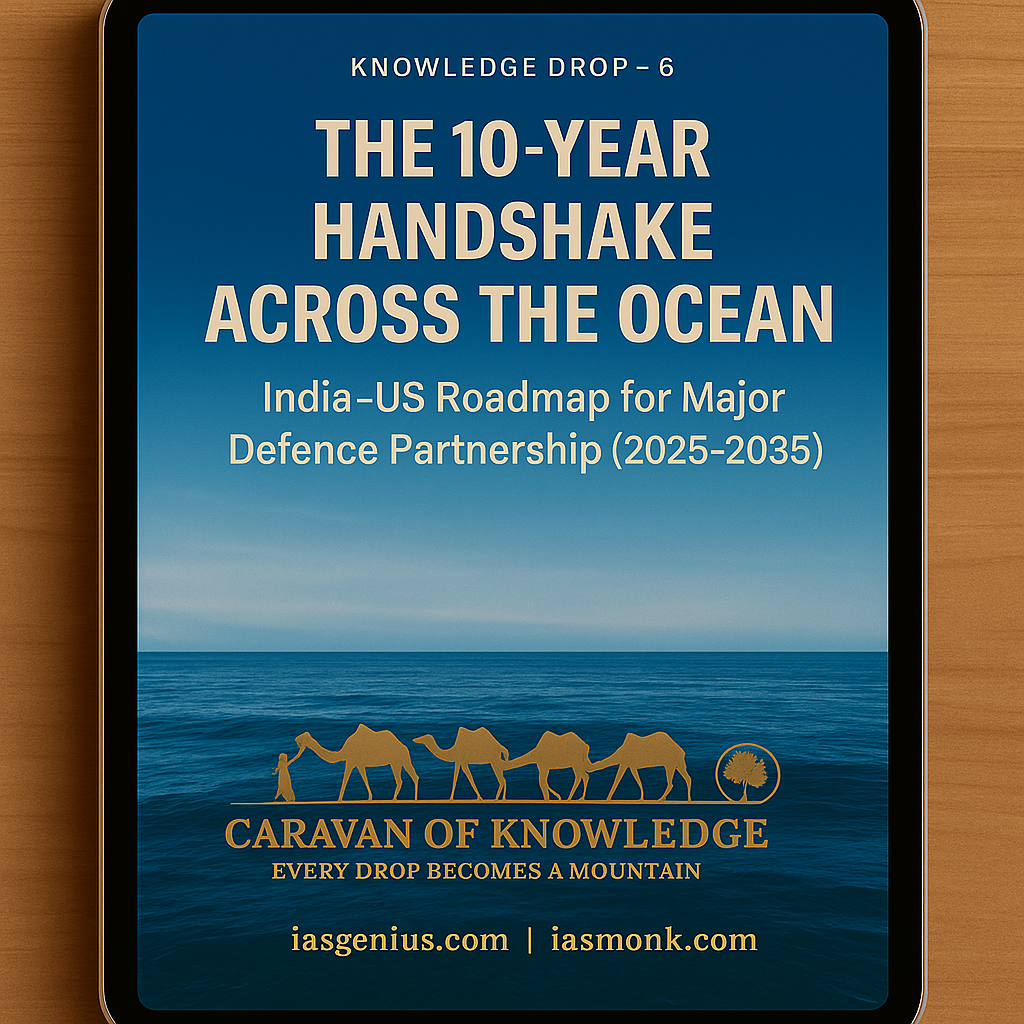
THE 10-YEAR HANDSHAKE ACROSS THE OCEAN
India–US Roadmap for Major Defence Partnership (2025–2035)
NATIONAL HERO — PETAL 006
November 3, 2025
GS2 – International Relations | GS3 – Defence & Security
🌬️ INTRO WHISPER
When two oceans meet,
their waves do not merge —
they learn to move together.
So too with great nations.
🔍 CONTEXT
India and the United States have signed a landmark 10-year roadmap to steer strategic collaboration across the full spectrum of defence cooperation.
The agreement was formalised during Defence Minister Rajnath Singh’s meeting with U.S. counterpart Pete Hegseth on the sidelines of the 12th ASEAN Defence Ministers’ Meeting Plus (ADMM-Plus) in Kuala Lumpur.
This long-term roadmap signals the most structured and ambitious India–US defence alignment to date.
🔑 Key Features of the 10-Year Roadmap (2025–2035)
1️⃣ Joint Defence Production & Technology Co-Development
• Co-production of advanced munitions
• Joint development of drones and surveillance aircraft
• Enhanced intelligence sharing
• Deepened collaboration on aerospace and naval technologies
This aligns directly with Make in India, Make for the World.
2️⃣ Strengthened Joint Military Exercises
India and the U.S. agreed to expand and modernise major bilateral and multilateral exercises:
• Yudh Abhyas (high-altitude warfare)
• Malabar (naval power projection)
• Tiger Triumph (tri-service humanitarian & disaster response)
Interoperability is the core objective.
3️⃣ Boosting India’s Defence Industrial Base
The roadmap focuses on:
• Building resilient supply chains
• Reducing India’s import dependency
• Increasing domestic manufacturing capacity
• Enhancing India’s export profile as a defence producer
4️⃣ Direct Defence Sales and Shared R&D
The pact encourages:
• Direct government-to-government defence sales
• Joint investigation of emerging technologies like AI-enabled defence systems
• Faster procurement pathways under U.S. Foreign Military Sales (FMS)
🇮🇳 India–US Defence Cooperation: A Timeline of Trust
Major Defence Partner (MDP) – 2016
The U.S. recognised India as a Major Defence Partner, creating a unique framework for technology access and strategic coordination.
Foundational Agreements (2016–2020)
- LEMOA (2016) – Reciprocal logistics access
- COMCASA (2018) – Secure communications interoperability
- BECA (2020) – Geo-spatial intelligence sharing
- Industrial Security Annex (2019) – Enhancing defence industrial cooperation
Together, these form the backbone of the strategic partnership.
2024–2025 Deepening Cooperation
• Security of Supply Arrangement (SOSA) – Ensures uninterrupted defence supply chains
• Liaison Officers Agreement – Embeds Indian officers in U.S. commands
• Yudh Abhyas 2025 – Two-week high-altitude joint exercise in Alaska
India’s defence inventory already includes:
Super Hercules • Globemaster • Poseidon P-8I
Chinooks • Seahawks • Apaches
Harpoon Missiles • M777 Ultralight Howitzers
This is one of India’s most diversified and potent U.S.-origin defence portfolios.
⚠️ Challenges & Structural Frictions
1️⃣ India’s Strategic Autonomy
India’s long-standing ties with Russia complicate American expectations for alignment, especially during global crises.
2️⃣ U.S. Export Controls & IP Restrictions
ITAR limitations and intellectual property concerns can restrict India’s access to cutting-edge technologies like next-gen propulsion and stealth systems.
3️⃣ Interoperability Issues
Differences in military doctrines, equipment standards, and operating platforms can slow down integration.
4️⃣ Supply Chain Dependencies
High dependence on U.S.-origin components can affect self-reliance if geopolitical climates shift.
🌍 Strategic Significance of the Roadmap
1️⃣ Indo-Pacific Stability
The pact reinforces the India–U.S. security architecture in the Indo-Pacific, especially in the face of rising Chinese assertiveness.
2️⃣ Defence Modernisation
Joint technologies and direct sales accelerate India’s transition toward a modern, network-centric force.
3️⃣ Global Defence Supply Chains
India becomes an emerging node in secure, diversified military supply chains.
4️⃣ Multilateral Influence
India’s participation in ADMM-Plus and QUAD gains strategic depth through stronger U.S. synergy.
📘 GS MAPPING
GS2: International Relations, Bilateral Cooperation, India–US Relations
GS3: Security, Defence Manufacturing, Technology Interoperability, Strategic Forces
🌟 CLOSING THOUGHT — IAS MONK
Partnership is not the merging of strengths
but the widening of horizons.
And for nations that guard their autonomy like treasure,
a shared horizon is the boldest step of all.
Target IAS-26: Daily MCQs :
📌 Prelims Practice MCQs
Topic: India–US 10-Year Defence Partnership Roadmap (2025–2035)
TYPE 1 — How Many Statements Are Correct?
Consider the following statements regarding India–US defence cooperation:
1)The 2025 ten-year roadmap focuses on joint defence production and enhancing military interoperability.
2)India and the U.S. have already signed foundational agreements like LEMOA, COMCASA, and BECA.
3)The roadmap was signed during the QUAD Summit in Hawaii.
4)The agreement supports “Make in India, Make for the World” to boost indigenous defence manufacturing.
A) Only two
B) Only three
C) All four
D) Only one
🌀 Didn’t get it? Click here (▸) for the Correct Answer & Explanation.
Correct Answer: B) Only three
Explanation:
1)✅ True – Joint production and interoperability are core components of the roadmap.
2)✅ True – LEMOA, COMCASA and BECA were signed between 2016–2020.
3)❌ False – It was signed during ADMM-Plus in Kuala Lumpur, not a QUAD summit.
4)✅ True – The pact explicitly supports “Make in India, Make for the World.”
Correct statements = 1, 2 and 4 → Option B.
MCQ 2 TYPE 2 — Two-Statement Type
Consider the following:
1)The India–US roadmap includes expansion of multilateral exercises like Malabar and Tiger Triumph.
2)The roadmap restricts India from conducting defence exercises with non-U.S. partners.
A) Only 1 is correct
B) Only 2 is correct
C) Both are correct
D) Neither is correct
🌀 Didn’t get it? Click here (▸) for the Correct Answer & Explanation.
Correct Answer: A) Only 1 is correct
Explanation:
1)✅ True – Expansion of Malabar, Tiger Triumph and Yudh Abhyas is part of the plan.
2)❌ False – The roadmap does not restrict India’s autonomy in military exercises.
MCQ 3 TYPE 3 — Code-Based Statement Selection
Which of the following correctly describe challenges in India–US defence cooperation?
1)India’s strategic autonomy and ties with Russia complicate U.S. expectations.
2)Differences in military equipment standards affect interoperability.
3)The United States imposes no export-control restrictions on high-end defence technologies.
A) 1 and 2 only
B) 1 and 3 only
C) 2 and 3 only
D) 1, 2 and 3
🌀 Didn’t get it? Click here (▸) for the Correct Answer & Explanation.
Correct Answer: A) 1 and 2 only
Explanation:
1)✅ True – India’s Russia partnership is a strategic friction point.
2)✅ True – Equipment and doctrinal differences create interoperability issues.
3)❌ False – U.S. export controls like ITAR continue to restrict technology access.
MCQ 4 TYPE 4 — Direct Factual Question
Which of the following exercises is a tri-service India–U.S. exercise focused on humanitarian assistance and disaster relief (HADR)?
A) Yudh Abhyas
B) Cope India
C) Tiger Triumph
D) Vajra Prahar
🌀 Didn’t get it? Click here (▸) for the Correct Answer & Explanation.
Correct Answer: C) Tiger Triumph
Explanation:
Tiger Triumph is the only tri-service India–U.S. exercise focused on HADR.
MCQ 5 TYPE 5 — UPSC 2025 Linkage Reasoning Format (I, II, III)
Consider the following statements:
Statement I:
The India–U.S. 10-year defence roadmap strengthens India’s indigenous manufacturing and long-term military modernisation.
Statement II:
The roadmap promotes joint development of advanced systems like drones, munitions, and surveillance aircraft.
Statement III:
The roadmap prohibits direct government-to-government defence sales between India and the U.S.
Which one of the following is correct in respect of the above statements?
(a) Both Statement II and Statement III are correct and both of them explain Statement I
(b) Both Statement II and Statement III are correct but only one of them explains Statement I
(c) Only one of the Statements II and III is correct and that explains Statement I
(d) Neither Statement II nor Statement III is correct
🌀 Didn’t get it? Click here (▸) for the Correct Answer & Explanation.
Correct Answer: (c)
Explanation:
Statement II: ✅ True – Joint development directly contributes to India’s long-term defence modernisation.
Statement III: ❌ False – The roadmap encourages, not prohibits, direct defence sales.
Only Statement II is correct, and it explains Statement I → Option (c).
High Quality Mains Essay For Practice :
Word Limit 1000-1200
A Decade of Steel and Trust: The India–US Roadmap for Defence Partnership (2025–2035)
International relations, like the ocean, move through cycles of calm, turbulence, and renewed alignment. In 2025, India and the United States marked a new phase in their strategic journey by signing a 10-year Roadmap for Major Defence Partnership, signalling not just a policy shift but a generational shift in how the world’s largest democracy and the world’s oldest democracy view their shared future.
The signing, held at the sidelines of the 12th ASEAN Defence Ministers’ Meeting Plus (ADMM-Plus) in Kuala Lumpur, was more than a bilateral exchange; it was a reaffirmation that both nations see their destinies intertwined in a world of growing insecurity, contested seas, emerging technologies, and shifting power balances.
This roadmap represents the most structured, long-term, and ambitious defence alignment India and the United States have ever attempted — a blueprint not merely for cooperation but for co-creation.
The Strategic Moment: Why Now?
The Indo-Pacific is undergoing a profound transformation. Power rivalries sharpen, sea lanes tighten, new technologies redefine warfare, and regional frameworks adapt to rising tensions. Within this fluid environment, stable partnerships provide the anchor for national security.
For India, the decade ahead is crucial:
• It is modernising its forces.
• It is diversifying its defence imports.
• It is emerging as a defence manufacturer.
• It is asserting its strategic autonomy.
For the United States, maintaining a stable, multipolar Indo-Pacific is essential to prevent unilateral dominance by any power. India, with its geography, population, and democratic resilience, becomes a natural and necessary partner.
Thus, the 2025 roadmap is not a sudden initiative — it is an organic evolution of two decades of strengthening trust.
A Decade of Cooperation: What the Roadmap Envisions
1. Co-Development and Co-Production
One of the pillars of the roadmap is joint creation of defence platforms.
The focus areas include:
• Precision munitions
• Surveillance aircraft
• Advanced drones
• Naval systems
• Joint research on defence AI
• Aerospace components
• Secure communications systems
This approach transforms India from a buyer to a partner and aligns with India’s vision of “Make in India, Make for the World.”
It shifts the relationship from transactional purchases → to technological interdependence → to industrial partnership.
2. Strengthening Military Interoperability
Interoperability is not merely about joint exercises — it is about learning to think, operate, and respond together.
The roadmap expands:
• Yudh Abhyas (high-altitude warfare)
• Malabar (naval power projection with Japan & Australia)
• Tiger Triumph (tri-service HADR)
It encourages more cross-deployment, shared simulation environments, and real-time intelligence exchange.
For the first time, the roadmap aims at making India and the U.S. capable of operating seamlessly in multinational contingencies.
3. Defence Sales, Supply Chains, and Resilience
The roadmap strengthens government-to-government sales through systems like:
• C-130J Super Hercules
• P-8I Poseidon
• C-17 Globemaster
• Apache helicopters
• Chinooks
• Seahawk multi-role choppers
• Harpoon missiles
• M777 ULH howitzers
But more importantly, it builds a Security of Supply Arrangement (SOSA) into long-term planning — ensuring uninterrupted access to spares, parts, and electronics during emergencies.
This is essential for strategic autonomy in wartime.
4. Embedding Defence Officers & Expanding Liaison Presence
The agreement to assign liaison officers deepens institutional connectivity:
Indian officers in U.S. commands → American officers in Indian establishments.
This institutionalises trust beyond governments — directly into military headquarters, war rooms, and operational planning desks.
Historical Foundations: The Path that Led Here
India–U.S. defence cooperation, once hostile during the Cold War, has evolved dramatically.
Major Defence Partner (MDP) – 2016
A status given only to India. It opened avenues for high-end technologies.
Foundational Agreements (2016–2020)
These are the four pillars of India–US defence architecture:
1. LEMOA (2016) – Mutual logistics access
2. COMCASA (2018) – Secure communications
3. BECA (2020) – Geo-spatial intelligence sharing
4. Industrial Security Annex (2019) – Protecting sensitive technologies
Together, these allow:
• Refuelling and base access
• Linking encrypted systems
• Sharing accurate battlefield maps
• Protecting classified technologies
Without these, the 2025 roadmap would have been impossible.
Benefits to India
1. Modernising India’s Military Faster
Joint development compresses timelines and reduces reliance on imports.
2. Manufacturing for the World
India can rise as a global defence exporter — especially drones, munitions, spare parts, sensors, and electronics.
3. Leveraging U.S. Technology Depth
Advanced ISR (Intelligence, Surveillance, Reconnaissance), jet engine technology, anti-submarine warfare tools, and secure communications elevate India’s capabilities.
4. Indo-Pacific Security Architecture
India becomes a shaping force — not just a participant — in QUAD, ADMM-Plus, and Indo-Pacific defence frameworks.
Challenges and Structural Tensions
1. India’s Strategic Autonomy
India avoids alliances; the U.S. expects alignment.
Managing this tension will define the partnership.
2. Russia Factor
India’s legacy dependence on Russian hardware (S-400, Su-30MKI, Kilo submarines, BrahMos) complicates U.S. cooperation.
3. Export Controls
U.S. ITAR restrictions hinder transfer of high-end systems.
4. Interoperability Gaps
Platform differences, operational doctrines, and procurement cycles slow integration.
5. Political Changes
Long-term defence roadmaps must withstand elections, leadership shifts, and geopolitical turbulence.
Yet despite these challenges, the trajectory is forward-leaning, pragmatic, and sustained.
Strategic Significance Beyond Defence
The roadmap has wider implications:
1. Economic
India becomes a key node in global defence supply chains.
2. Geopolitical
India gains influence in Pacific and East Asian security architecture.
3. Technological
Joint R&D accelerates India’s defence tech ecosystem.
4. Diplomatic
Defence cooperation elevates India’s overall partnership with the U.S. — in trade, tech, health, climate, cyber, and space.
Conclusion: A Decade Written in Steel
The India–US 10-Year Defence Roadmap is not merely an agreement — it is a strategic narrative about two nations stepping into a future where cooperation is power.
Partnerships between sovereign nations are not about surrendering autonomy; they are about expanding horizons without losing identity.
India today stands at a moment where its global role is being rewritten — not by the ambitions of others, but by the confidence it carries within.
As the Indian philosopher K. Subrahmanyam once observed:
“National power grows not by what you hold in your hand, but by who stands at your side when history begins to turn.”
In Gyeongju, history turned — and India and the U.S. chose to turn together.