













🌑Knowledge Drop – 004 : THE GROUND THAT SINKS BELOW OUR CITIES | Prelims MCQs & High Quality Mains Essay
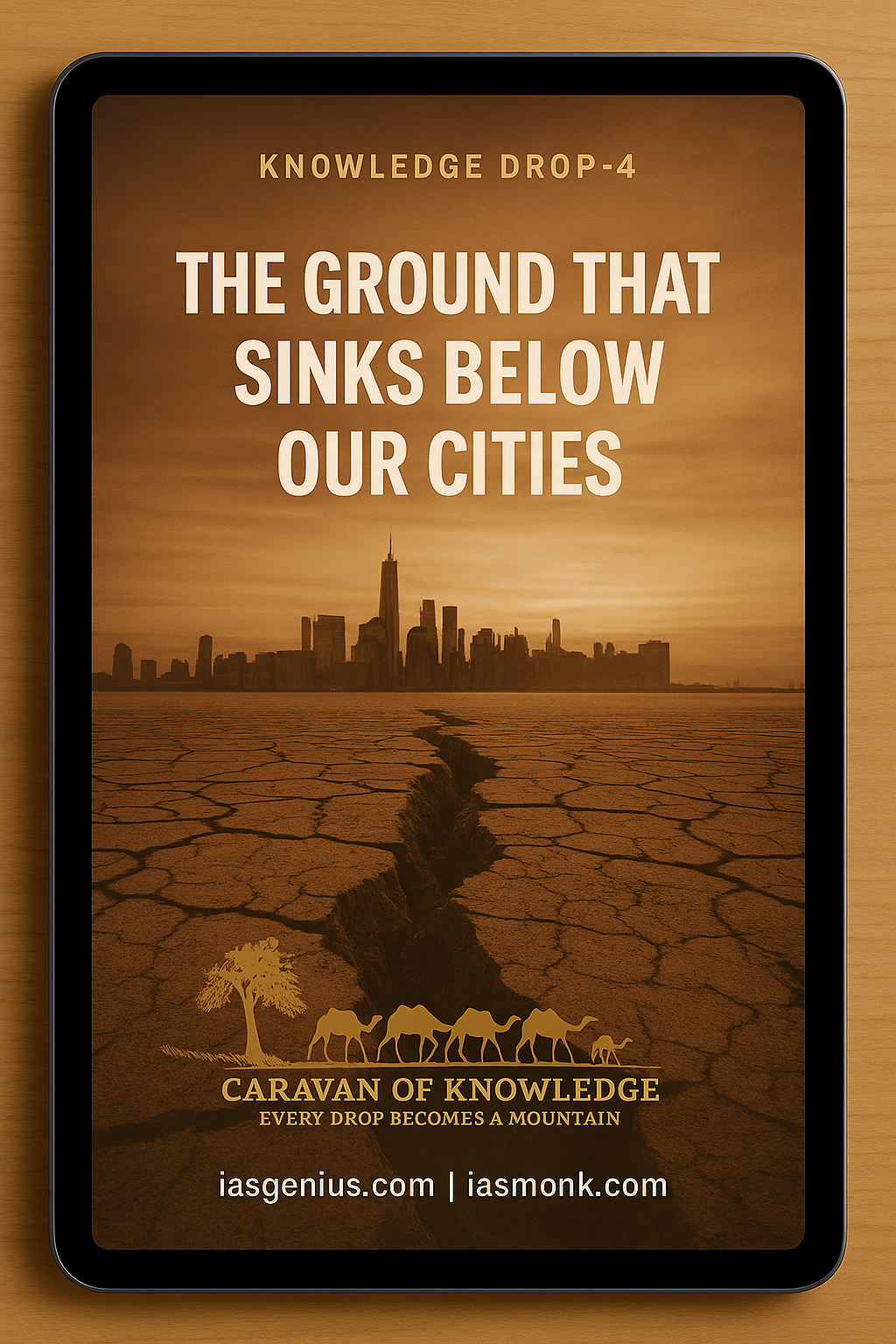
🌑 KNOWLEDGE DROP – 4
THE GROUND THAT SINKS BELOW OUR CITIES
Land Subsidence Threat in India’s Big Cities
NATIONAL HERO — PETAL 002
November 2, 2025
GS1 – Urbanisation, Settlement Patterns, Urban Risks
🌬️ INTRO WHISPER
When a city grows faster than the land beneath it,
the earth remembers — and quietly sinks to remind us
that gravity is also a form of governance.
🔍 CONTEXT
A major study titled “Building Damage Risk in Sinking Indian Megacities” has sounded an alarm:
878 km² of land across Delhi, Chennai, Mumbai, Kolkata, and Bengaluru is sinking, exposing nearly 1.9 million people to long-term risk.
Urbanisation has risen vertically.
But the land below is moving downward.
This is India’s new invisible disaster.
🌏 What is Land Subsidence?
According to NOAA, land subsidence refers to the gradual sinking or lowering of the Earth’s surface due to the loss of underground support — such as groundwater, minerals, or compressible soils.
It can be:
Natural:
• Karst processes
• Tectonic movements
• Soil compaction
Human-Induced:
• Groundwater over-extraction
• Heavy construction
• Mining
• Waste dumping
From Jakarta to Manila to Joshimath, subsidence is now a global megacity crisis.
📌 Key Findings of the Study
1️⃣ 1.9 million people at risk
Across five megacities, millions are living on sinking ground.
2️⃣ 23,000+ buildings face severe damage risk
If current trends continue for 50 years, structural failures may multiply.
3️⃣ 2,400 buildings already high-risk
Especially in Delhi, Chennai, and Mumbai.
4️⃣ Soft-soil cities are more vulnerable
- High risk: Delhi, Kolkata, Chennai
- Relatively stable: Bengaluru (built on hard rock)
5️⃣ Rapid urbanisation is intensifying ground deformation
Tower weight + groundwater depletion = double stress.
🔥 Causes of Land Subsidence in India
1. Excessive Groundwater Extraction
The biggest cause.
Over-extraction compacts aquifers → ground sinks.
2. Weight of High-Rise Buildings
Skyscrapers + dense colonies = downward load on weak soil.
3. Inefficient Urban Planning
Construction on reclaimed land, wetlands, and soft alluvial plains multiplies deformation.
4. Climate Stress
Irregular rainfall & paved surfaces → less recharge → deeper borewells → more sinking.
5. Natural Causes
- Tectonic movements
- Fault lines
- Karst dissolution
6. Unregulated Waste Dumping
Landfills on marshy soils exert enormous vertical pressure.
💥 Impacts of Subsidence
1. Structural & Road Damage
• Cracks in buildings
• Tilting structures
• Distorted roads
• Pipeline failures
2. Increased Flooding Risk
Sinking coastal cities (Mumbai, Chennai) become flood magnets.
3. Higher Economic Costs
Future repair costs may exceed hundreds of billions.
4. Compounded Hazards
Subsidence amplifies:
- Earthquake impacts
- Storm surges
- Sea-level rise
Urban safety becomes multi-layered and unpredictable.
🛠 Way Forward
1. InSAR Monitoring
Use satellite radar + ground sensors for early warning.
2. Hydrogeological Zoning
Make soil + aquifer mapping mandatory before large construction.
3. Strengthen Building Codes
Adopt foundation systems suited to differential soil movement.
4. Restrict Groundwater Extraction
Promote managed aquifer recharge, rainwater harvesting.
5. Urban Planning Reform
Stop construction on wetlands, floodplains, reclaimed land.
6. Climate-Resilient Infrastructure
Develop drainage, pumping, and flood barriers for vulnerable zones.
🧭 GS MAPPING (Simple & Accurate)
GS1: Urbanisation challenges, urban morphology, settlement patterns
GS3: Disaster management, climate impacts, infrastructure vulnerability
GS2: Governance, urban policy, regulation of groundwater
✨ CLOSING THOUGHT — IAS MONK
Cities rise on dreams,
but they stand on soil.
And soil does not lie —
it tells us exactly how much it can bear.
Target IAS-26: Daily MCQs :
📌 Prelims Practice MCQs
Topic: Carbon Capture
MCQ 1 – Type 1: How many of the above statements are correct?
Q. Consider the following statements regarding land subsidence in Indian cities:
1)Land subsidence occurs only due to natural geological processes and cannot be caused by human activities.
2)Delhi, Chennai, and Kolkata are more vulnerable to land subsidence because they are built on soft alluvial soils.
3)Excessive groundwater extraction is a major cause of land subsidence in Indian megacities.
4)Bengaluru faces higher subsidence risk than Delhi because it is built on hard igneous rock formations.
A) Only two
B) Only three
C) All four
D) Only one
🌀 Didn’t get it? Click here (▸) for the Correct Answer & Explanation
✅ Correct Answer: A) Only two
🧠 Explanation:
1)❌ False – Human activities such as over-extraction of groundwater, mining, and construction load also cause subsidence.
2)✅ True – Delhi, Chennai and Kolkata lie on soft alluvial soils which deform easily.
3)✅ True – Groundwater withdrawal is the most significant cause of subsidence in Indian megacities.
4)❌ False – Bengaluru is built on hard igneous rock and is less vulnerable, not more.
MCQ 2 – Type 2: Two Statements Based
Q. Consider the following:
1)Land subsidence increases the risk of flooding in coastal cities such as Mumbai and Chennai.
2)Land subsidence reduces the structural load on buildings, making them safer during earthquakes.
A) Only 1 is correct
B) Only 2 is correct
C) Both are correct
D) Neither is correct
🌀 Didn’t get it? Click here (▸) for the Correct Answer & Explanation
✅ Correct Answer: A) Only 1 is correct
🧠 Explanation:
1)✅ True – Lowering of land height increases waterlogging and makes storm surges more destructive.
2)❌ False – Subsidence weakens soil support and increases earthquake vulnerability.
MCQ 3 – Type 3: Which of the statements is/are correct?
Q. Which of the following are correct regarding the causes of land subsidence?
1)Unregulated waste dumping on marshy soils increases vertical ground pressure.
2)Groundwater recharge due to heavy rainfall prevents land subsidence in major cities.
3)Construction on reclaimed land amplifies the sinking of urban zones.
A) 1 and 2 only
B) 1 and 3 only
C) 2 and 3 only
D) 1, 2 and 3
🌀 Didn’t get it? Click here (▸) for the Correct Answer & Explanation
✅ Correct Answer: B) 1 and 3 only
🧠 Explanation:
1)✅ True – Waste piles compact weak soil and accelerate sinking.
2)❌ False – Urban sealing prevents proper recharge; rainfall alone cannot stop subsidence.
3)✅ True – Reclaimed land is structurally unstable and prone to sinking.
MCQ 4 – Type 4: Direct Fact
Q. Which satellite-based technique is widely used to monitor land subsidence?
A) GNSS
B) LiDAR
C) InSAR
D) RADAR Altimetry
🌀 Didn’t get it? Click here (▸) for the Correct Answer & Explanation.
✅ Correct Answer: C) InSAR
🧠 Explanation:
• InSAR uses radar interferometry to measure ground deformation with high precision
MCQ 5 TYPE 5 — UPSC 2025 Reason–Linkage Format (I, II, III)
Consider the following statements:
Statement I:
Land subsidence intensifies urban disaster risk in Indian megacities, especially during extreme rainfall and coastal flooding events.
Statement II:
Land subsidence lowers ground elevation, which increases waterlogging, delays drainage, and makes coastal storm surges more destructive.
Statement III:
Land subsidence strengthens the structural resilience of buildings by reducing pressure between soil layers.
Which one of the following is correct in respect of the above statements?
(a) Both Statement II and Statement III are correct and both of them explain Statement I
(b) Both Statement II and Statement III are correct but only one of them explains Statement I
(c) Only one of the Statements II and III is correct and that explains Statement I
(d) Neither Statement II nor Statement III is correct
🌀 Didn’t get it? Click here (▸) for the Correct Answer & Explanation.
Correct Answer : (c) Only one of the Statements II and III is correct and that explains Statement I
🧠Explanation:
Statement II: ✅ True – Lower elevation directly increases vulnerability and explains why subsidence worsens urban disasters.
Statement III: ❌ False – Subsidence weakens structures; it does not strengthen resilience.
Only Statement II is correct, and it explains Statement I → Option (c).
High Quality Mains Essay For Practice :
Word Limit 1000-1200
THE SINKING CITIES OF INDIA:
Understanding Land Subsidence and the Future of Urban Survival**
Urbanisation is often portrayed as India’s unstoppable march toward modernity. Megacities rise, skylines spread, and economic life grows denser each year. Yet beneath this vast, visible expansion, an invisible crisis is unfolding — one that moves slowly, silently, and relentlessly downward. This crisis is land subsidence, the gradual sinking of the Earth’s surface caused by natural processes or human pressures. In recent years, this phenomenon has emerged as one of the most complex and least understood threats to India’s metropolitan future.
A recent study titled “Building Damage Risk in Sinking Indian Megacities” has revealed that nearly 878 km² of land across five major Indian cities — Delhi, Chennai, Mumbai, Kolkata and Bengaluru — is undergoing measurable subsidence. Nearly 1.9 million people and over 23,000 buildings face long-term structural risk if current patterns persist for the next 50 years. What makes the issue even more unsettling is that over 2,400 buildings in Delhi, Mumbai and Chennai are already experiencing high subsidence-related deformation. India’s urban centres, celebrated as engines of growth, are also becoming laboratories of sinking ground.
Understanding the Science of Subsidence
The National Oceanic and Atmospheric Administration (NOAA) defines land subsidence as the gradual settling or sudden sinking of the Earth’s surface due to the removal of subsurface materials — such as soil, water or minerals. Subsidence can be natural, arising from tectonic adjustments, karst processes or the compaction of soft alluvial sediment. But it can also be human-induced, emerging from excessive groundwater extraction, the weight of built infrastructure, mining activities and unregulated construction.
Across the world, major cities are succumbing to this slow descent. Jakarta, Manila, Bangkok, Tehran, Mexico City and even parts of Houston face serious sinking hazards. In India, the most dramatic example has been Joshimath, where geologically unstable slopes combined with infrastructural pressure triggered widespread cracks in buildings and roads. But what is unfolding in the plains — Delhi’s alluvial basin, Kolkata’s deltaic sprawl, and Chennai’s coastal wetlands — is far more extensive, and potentially far more disruptive.
Why India’s Megacities Are Sinking
India’s metropolitan geography makes subsidence a structural danger. Delhi, Kolkata and Chennai lie on thick layers of water-saturated alluvium — fertile soil for agriculture but fragile ground for vertical expansion. The soft soil compresses under pressure, and as groundwater is withdrawn, aquifers collapse like deflating cushions.
Excessive groundwater extraction is the most dangerous driver. In many urban zones, groundwater levels have dipped by 1–1.5 metres annually. Aquifers that took centuries to fill are being emptied within decades. The moment water is removed from fine-grained clay or silt layers, particles rearrange tightly, reducing pore spaces and causing the land above to sink.
The load of urban infrastructure amplifies this deformation. High-rise clusters, expressways, flyovers and commercial complexes exert enormous downward force. In zones where the soil is weak, this pressure causes differential settling — some structures tilt, some crack, some sink gradually out of alignment. Cities like Mumbai and Chennai, built partly on reclaimed coastal land, are especially prone to such deformation.
Inefficient urban planning is another culprit. Construction on wetlands, floodplains, river basins, and soft-soil edges continues despite warnings. These fragile zones, originally meant to absorb water, now carry vertical loads they were never designed to bear. Municipal approvals often overlook hydrogeological constraints, focusing instead on economic growth.
Added to this is climate stress. With erratic rainfall and expanding concrete surfaces, natural groundwater recharge declines. Heavy rains are often wasted as runoff, while summers push borewells deeper. Over time, this creates a vicious cycle: deeper pumping → greater subsidence → increased flooding → greater dependence on groundwater → accelerated subsidence.
Natural causes, too, play a role — tectonic activity, geological faults and dissolution of underground rocks in karst zones. But the human footprint far outweighs these in most urban contexts.
The Human and Economic Implications
Subsidence is not merely a geological concern — it is an urban existential issue. As land sinks, infrastructure begins to fail. Buildings develop cracks, walls tilt, roads wrinkle, sewage lines rupture, and underground pipelines distort. Drainage systems designed with old elevation profiles no longer function properly, causing chronic waterlogging.
Nowhere is the danger more severe than in coastal megacities. In Mumbai and Chennai, subsidence combines with the rising sea level to create compound flooding hazards. As land lowers, storm surges penetrate deeper inland. Heavy rainfall lingers longer over depressed zones, turning them into bowls of stagnant water. The city becomes both more flood-prone and slower to recover.
Economically, the cost of repairing subsidence-related damage will run into hundreds of billions of rupees in coming decades. But perhaps the gravest concern is the multi-hazard amplification effect. Subsidence increases vulnerability to earthquakes, since buildings on sinking ground experience greater shaking and uneven foundation stress. In coastal areas, it magnifies cyclonic storm surge intensity. In riverine cities, it worsens fluvial flooding.
Subsidence is not an isolated hazard — it is a silent multiplier of every other urban risk.
Urban Futures on Unstable Ground
As India pushes toward a $5 trillion economy, its cities will bear unprecedented pressure. Yet economic ambition cannot be built on geological ignorance. The way forward requires a structural rethinking of how cities interact with the ground beneath them.
The first step is monitoring. Satellite-based InSAR (Interferometric Synthetic Aperture Radar) and ground sensors must be deployed across megacities. InSAR can detect millimetre-level land deformation, allowing early detection of emerging hotspots.
Second, cities must adopt urban hydrogeological zoning. Before any high-rise cluster, metro line, flyover or industrial zone is approved, mandatory soil analysis, aquifer mapping and load-bearing simulation must be carried out. Today’s practice of approving construction without sub-surface science is not just inefficient — it is dangerous.
Third, strengthened building codes are essential. Foundation designs should be tailored to the soil’s bearing capacity, especially in alluvial zones. Differential settlement must be anticipated, not treated as a post-construction surprise.
Fourth, cities need managed aquifer recharge, rooftop rainwater harvesting mandates, and strict limits on borewell extraction in critical zones. The value of groundwater is not merely economic — it is structural.
Finally, India must recognise that reclamation of wetlands and floodplains is environmentally and geologically unviable. Urban development cannot continue at the cost of long-term stability.
Conclusion
Land subsidence is not a dramatic disaster like an earthquake or flood. It has no single day of destruction. Instead, it is the slow betrayal of the ground we trust — the surrender of soil under accumulated human pressure. That makes it harder to perceive but far more dangerous in scale.
Cities are among humanity’s most ambitious creations. But the earth beneath them is older, wiser and less negotiable. It does not bend to economic timelines or political speeches. It follows laws of physics that do not change with our convenience.
And so, in the end, land subsidence teaches a profound lesson about civilisation:
Before a city rises, the land must agree to hold it.
As the UPSC philosopher K. Subrahmanyam once wrote:
“No city survives on its skyline. It survives on its foundation.”